
Cart
0
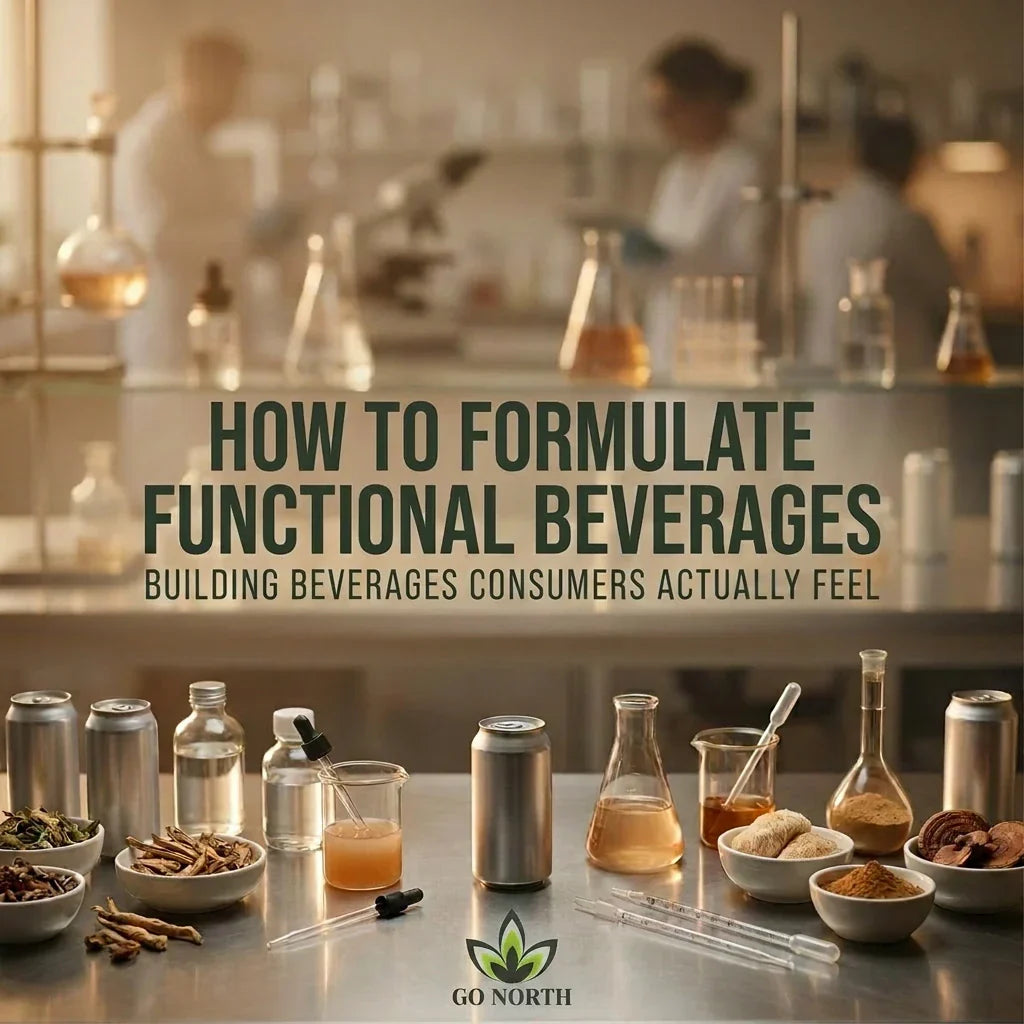
How To Formulate Functional Beverages
Building beverages consumers actually feel.

Table Of Contents
Modern consumers no longer buy functional beverages simply because they contain trendy ingredients.
They buy products that create a noticeable experience, fit naturally into daily routines, taste good enough to purchase again, and feel trustworthy from both a formulation and branding standpoint.
Functional beverages now extend far beyond narrow ingredient categories. Brands are increasingly developing beverages centered around adaptogens, nootropics, botanical extracts, functional mushrooms, electrolytes, amino acids, vitamins, minerals, hydration systems, recovery support, and performance-focused wellness ingredients.
Today’s functional beverage market is increasingly shaped by formulation science, ingredient transparency, sensory quality, manufacturing consistency, shelf-life performance, bioavailability, clean-label positioning, and consumer-perceivable outcomes.
That creates a major challenge for beverage brands.
Formulating a functional beverage that actually works is significantly more difficult than simply adding adaptogens, nootropics, mushrooms, vitamins, minerals, or botanicals into flavored water.
Many products fail long before consumers ever take a second sip.
Some separate on shelves. Some lose potency within months. Some taste medicinal. Some are overloaded with ingredients yet produce no noticeable effect. Others become difficult to scale once manufacturing realities enter the equation.
This guide breaks down how modern functional beverages are developed, from ingredient architecture and flavor systems to manufacturing strategy, stability science, and shelf-life engineering.
Key takeaway: The brands that win are not the ones with the loudest labels. They are the ones that build beverages consumers genuinely feel, trust, and repurchase.
Why Most Functional Beverages Fail
Most functional beverages are engineered for marketing decks instead of repeat purchases.
A beverage may contain adaptogens, nootropics, botanical extracts, mushrooms, amino acids, electrolytes, vitamins, and minerals, but still fail commercially because the formulation was never designed as a complete system.
Modern beverage development requires balancing ingredient synergy, sensory experience, solubility, stability, processing conditions, packaging compatibility, shelf life, consumer psychology, and manufacturing economics at the same time.
The strongest functional beverages are built around complete ingredient systems, not isolated trend ingredients. That means every active, flavor, sweetener, acidulant, stabilizer, and processing decision should support the same consumer outcome.
The Real Formulation Challenges Behind Functional Beverages
Functional ingredients often create serious technical problems in beverage systems.
- Bitterness
- Sedimentation
- Oxidation
- Flavor drift
- Ingredient degradation
- Haze formation
- Poor dispersion
- Instability during pasteurization
- Shortened shelf life
Some botanical extracts become increasingly bitter over time. Certain vitamin systems may degrade under heat exposure depending on dwell time, pH, and processing conditions. Mineral-heavy formulas can create chalkiness or metallic aftertaste. Mushroom systems frequently introduce earthy notes that become more noticeable during storage.
Even ingredients that appear stable during early bench development can behave differently during full-scale processing, warehouse storage, freight exposure, refrigeration cycling, or long-term retail display.
Defining The Functional Goal Before Choosing Ingredients
The strongest functional beverages are built around one clear consumer outcome.
One of the biggest mistakes emerging brands make is trying to formulate energy, focus, calm, hydration, recovery, immunity, mood, and sleep into the same beverage.
That usually creates flavor conflicts, ingredient overload, weak efficacy, consumer confusion, and inflated ingredient costs.
The best-performing products typically dominate one primary use case while supporting one or two secondary benefits.
Step One: Define The Consumption Occasion
Before choosing ingredients, define when the beverage is consumed, why it is consumed, and what feeling the consumer expects afterward.
A morning productivity beverage should not feel heavy or sedating. An evening relaxation beverage should not rely on aggressive acidity or stimulant-driven positioning. A recovery beverage should feel replenishing, drinkable, and easy to return to after physical activity.
Example Functional Beverage Categories
| Beverage Goal | Common Ingredient Systems | Primary Formulation Priority |
|---|---|---|
| Energy | Natural caffeine, guarana, yerba mate, B vitamins | Clean stimulation and crisp flavor |
| Focus | L-theanine, Lion’s Mane, Rhodiola, citicoline | Smooth cognitive support |
| Calm | Ashwagandha, lemon balm, magnesium, L-theanine | Soft sensory profile |
| Recovery | Electrolytes, magnesium, tart cherry, amino acids | Hydration and replenishment |
Energy And Performance
Energy and performance beverages are typically consumed in the morning, before training, during productivity windows, or during mid-afternoon fatigue periods.
Common ingredient systems include natural caffeine, guarana, yerba mate, cordyceps, B vitamins, and electrolytes.
Focus And Cognitive Support
Focus beverages are designed around concentration, productivity, mental clarity, and reduced jitters.
Common systems include L-theanine, Lion’s Mane, Rhodiola, citicoline, and moderate caffeine.
Research around L-theanine and caffeine interaction research continues to influence modern focus beverage development.
Calm And Stress Support
Common systems include ashwagandha, magnesium glycinate, lemon balm, L-theanine, and calming botanicals.
Modern interest in botanical wellness systems has accelerated alongside growing adaptogen research and consumer demand for daily wellness rituals.
Recovery And Hydration
Common systems include electrolytes, magnesium, tart cherry, amino acids, and trace minerals.
Consumer demand for hydration-forward wellness products continues to rise alongside broader interest in hydration science and performance recovery beverages.
Ingredient Systems Must Be Built Around Synergy
Modern functional beverages rarely succeed because of one ingredient alone. They succeed because multiple ingredients work together cohesively.
Consumers may not understand formulation science, but they absolutely understand experience consistency.

Functional beverage ingredient systems should be built around synergy, stability, and consumer-perceivable experience.
The Problem With Pixie Dust Formulation
Many beverages intentionally underdose expensive ingredients while still featuring them prominently on packaging.
This practice is increasingly damaging trust in the category. Consumers are becoming more educated about effective dosage ranges, ingredient quality, transparency, and clinical relevance.
Adding a small amount of an ingredient typically studied at much higher levels may improve label aesthetics, but it rarely improves consumer experience.
Effective Functional Systems Are Usually Simpler
Overcomplicated formulas often create taste problems, instability, higher ingredient costs, manufacturing difficulty, and inconsistent sensory profiles.
In many cases, simpler systems outperform overloaded formulations because they are easier to stabilize, manufacture, flavor, and understand.
A well-built 4-ingredient system often outperforms a crowded formula with too many competing actives.
Bioavailability And Water Compatibility
One of the most overlooked aspects of beverage formulation is ingredient delivery.
Many functional compounds were not originally designed for water-based systems. Some clump, settle, oxidize, separate, degrade rapidly, or lose potency over time.
A beverage can contain excellent ingredients yet still perform poorly because the delivery system was weak.

Stability testing helps determine whether a beverage can survive real-world storage, transport, and retail conditions.
Solubility Problems Are Everywhere In Functional Beverages
Functional ingredients vary dramatically in water compatibility.
Some botanical extracts dissolve poorly. Mushroom powders may sediment. Oils require emulsification. Minerals can create precipitation. Certain adaptogens may destabilize low-pH systems.
This becomes even more challenging when combining carbonation, acidity, preservatives, natural flavors, minerals, vitamins, and heat processing.
Modern Beverage Delivery Systems
Advanced beverage formulations increasingly rely on emulsions, encapsulation systems, spray-dried ingredients, carrier systems, and suspension stabilizers.
These systems help improve ingredient dispersion, shelf stability, consistency, flavor integration, and consumer experience.
However, they also increase formulation complexity, ingredient cost, and manufacturing sensitivity.
There is no universal best delivery technology. The correct system depends on ingredient architecture, shelf-life goals, processing conditions, retail channels, cost targets, and packaging format.
Shelf Stability Is A Business Issue
Many founders underestimate how destructive shelf instability can become financially.
If a beverage separates, loses flavor, changes color, forms sediment, or loses efficacy, retailers lose confidence quickly.
Shelf-life engineering should begin during formulation development, not after commercialization.
Flavor Architecture Determines Repeat Purchase
Consumers may buy a beverage once because of the ingredients. They buy it repeatedly because of flavor.
Functional ingredients often introduce bitterness, dryness, metallic notes, earthy characteristics, and lingering aftertaste.
The challenge is not eliminating these entirely. The challenge is integrating them intelligently into the beverage experience.

Flavor architecture is one of the strongest drivers of repeat purchase in functional beverages.
Flavor Profiles That Work Well In Functional Systems
Citrus Systems
Citrus works well for energy beverages, hydration systems, adaptogenic beverages, and sparkling formulations.
Lemon, lime, yuzu, grapefruit, and mandarin profiles can brighten flavor, mask bitterness, and improve perceived freshness.
Berry Systems
Berry systems are useful for masking earthy notes, supporting mushroom integration, and creating wellness-oriented flavor profiles.
Blackberry, raspberry, blueberry, and acai often create stronger perceived body and smoother finish.
Botanical And Spice Systems
Botanical and spice profiles work well for evening beverages, premium wellness positioning, and adaptogenic products.
Ginger, hibiscus, mint, chai, and lavender can make functional ingredients feel intentional rather than hidden.
Sweetener Systems Require Precision
Reducing sugar sounds simple, but in practice it creates major formulation challenges.
Sugar contributes sweetness, mouthfeel, flavor balance, bitterness suppression, and texture perception.
Removing it often exposes harsh functional notes. That is why many successful beverages use layered sweetness systems combining cane sugar, monk fruit, stevia, erythritol, or allulose.
The goal is not maximum sweetness reduction. The goal is balance.
Acidity And Mouthfeel Shape Perceived Quality
Acid systems influence brightness, drinkability, bitterness masking, and flavor intensity.
Common acidulants include citric acid, malic acid, and tartaric acid.
Mouthfeel is equally important. A beverage that feels thin may seem cheap even when flavor quality is high.
Hydrocolloids and texture systems can improve body, but they must remain compatible with emulsions, carbonation, shelf stability, and heat processing.
Manufacturing Conditions Change Everything
Many formulations fail during scale-up because they were developed without manufacturing realities in mind.
A beverage that performs well in small-batch development may become unstable under commercial shear rates, high-temperature processing, filling line oxygen exposure, or extended production timelines.
Manufacturing is not a separate conversation from formulation. It is part of formulation.

Manufacturing strategy should influence formulation decisions before pilot production begins.
Common Beverage Processing Methods
Hot Fill
Hot fill typically uses elevated temperature, acidic pH, and thermal microbial control.
Advantages include accessible infrastructure and scalable production. Challenges include heat-sensitive ingredient degradation, flavor drift, and botanical instability.
Tunnel Pasteurization
Tunnel pasteurization sends filled containers through controlled heating cycles.
Advantages include improved package flexibility and controlled microbial reduction. Challenges include thermal stress, carbonation management, and stability validation requirements.
Aseptic Processing
Aseptic processing sterilizes the product and packaging separately before filling.
Advantages include improved ingredient protection and broader formulation flexibility. Challenges include higher minimum runs, higher cost, and limited facility access.
Quality Control Should Begin Before Production
Elite beverage brands build quality control systems into development from the beginning.
Testing should evaluate potency retention, microbial stability, flavor consistency, pH drift, sedimentation, oxidation, packaging interaction, and temperature abuse resistance.
A professional shelf-life program typically includes refrigerated testing, ambient testing, and accelerated heat testing.
Common checkpoints include 0 months, 1 month, 3 months, 6 months, 9 months, and 12 months.

Quality control validates whether the finished product remains stable, consistent, and commercially viable.
Labeling And Claims Matter More Than Ever
Consumers increasingly distrust vague wellness language.
Modern beverage brands perform better when they prioritize dosage transparency, ingredient clarity, realistic expectations, and clean positioning.
Most functional beverages rely on structure/function claims such as “supports focus,” “promotes calm,” “supports hydration,” or “supports recovery.”
Brands should also understand the broader GRAS ingredient framework when evaluating new functional ingredients and beverage systems.
Disease-treatment language creates significant regulatory risk.
The strongest brands position functionality intelligently without overpromising outcomes.
Working With A Beverage Development Partner
Most emerging brands should not attempt to handle formulation, flavor development, processing strategy, stability engineering, and manufacturing coordination completely alone.
An experienced formulation partner can reduce failed pilot runs, ingredient waste, reformulation cycles, manufacturing delays, and shelf-life failures.
The best formulation teams understand ingredient interactions, beverage chemistry, sensory development, processing compatibility, commercial manufacturing, packaging systems, cost engineering, and retail realities.
Developing A Functional Beverage?
Whether you are building a wellness beverage, recovery formula, nootropic RTD, hydration product, or modern functional drink, formulation strategy matters long before manufacturing begins.
Go North Hemp works with emerging and established beverage brands exploring scalable ingredient systems, beverage development, and modern wellness product innovation.
Final Thoughts
The functional beverage category is becoming more sophisticated every year.
Consumers are moving beyond novelty ingredients and flashy labels. They increasingly reward brands that deliver noticeable experience, great flavor, ingredient transparency, consistency, trust, and repeatability.
The future belongs to brands that understand formulation as a complete system: science, sensory experience, manufacturing, stability, psychology, branding, and economics working together.
Because the best functional beverages do not succeed because they sound functional. They succeed because consumers can actually feel the difference.
Frequently Asked Questions
What ingredients are commonly used in functional beverages?
Common functional beverage ingredients include adaptogens, nootropics, electrolytes, vitamins, minerals, amino acids, botanical extracts, mushroom extracts, and natural caffeine systems.
How are functional beverages stabilized?
Functional beverages are stabilized through proper pH control, emulsions, encapsulation systems, suspension stabilizers, processing alignment, packaging compatibility, and real-time shelf-life testing.
What makes a functional beverage successful?
A successful functional beverage balances noticeable functionality, strong flavor, ingredient transparency, shelf stability, manufacturing feasibility, and repeat purchase behavior.
What processing method is best for RTD functional beverages?
The best processing method depends on the formula, pH, packaging, ingredient sensitivity, shelf-life target, and production volume. Common options include hot fill, tunnel pasteurization, and aseptic processing.
How long should functional beverages last on shelves?
Many commercial RTD functional beverages target 9 to 12 months of shelf life, although some refrigerated or fresh-positioned products may intentionally use shorter timelines.
Why do functional beverages sometimes taste bitter?
Many functional ingredients, including botanicals, minerals, mushroom extracts, and amino acids, can introduce bitterness, dryness, earthiness, or metallic notes. Strong flavor architecture helps balance those sensory challenges.