
Cart
0
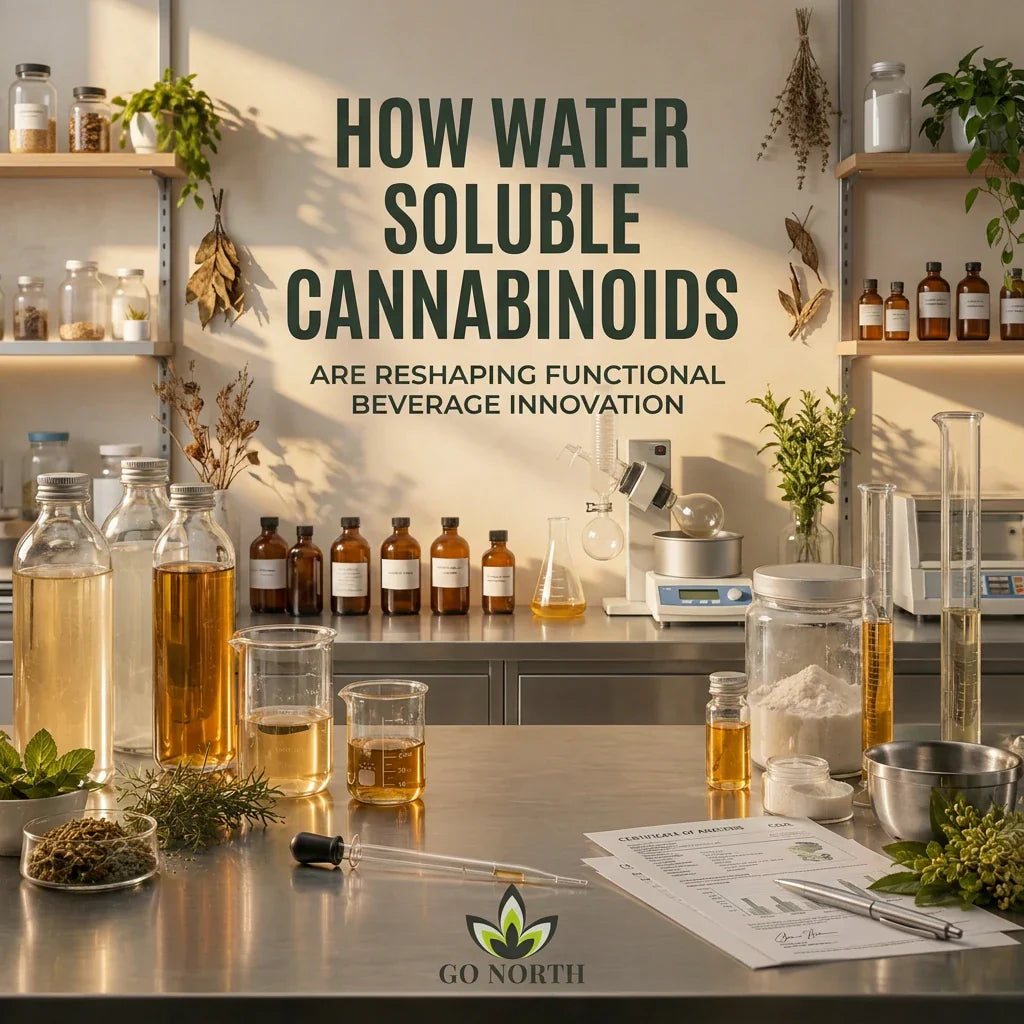

How Water Soluble Cannabinoids Are Reshaping Functional Beverage Innovation
Modern wellness brands are no longer competing on ingredients alone.
They are competing on absorption efficiency, formulation quality, stability, onset time, sensory experience, ingredient compatibility, and consumer trust.
Across functional beverages, botanical wellness products, nootropic formulations, recovery blends, and modern supplement systems, delivery technology has become just as important as the active ingredients themselves.
This shift is one reason water soluble cannabinoids are rapidly becoming a foundational ingredient system within next-generation wellness products.
For beverage developers, nutraceutical brands, private-label operators, and formulation teams, water compatible cannabinoid systems offer more than improved mixability. They create new opportunities around bioavailability, dose consistency, faster onset, and multi-functional formulation design.
As the broader functional wellness market evolves, companies building modern beverage systems increasingly need ingredients that work seamlessly alongside adaptogens, nootropics, botanical extracts, electrolytes, and performance-focused compounds.
Water soluble cannabinoids are helping make that possible.
Why Modern Wellness Brands Are Moving Toward Advanced Ingredient Systems
The functional beverage category has evolved significantly beyond traditional energy drinks and basic wellness supplements.
Today’s consumers increasingly expect products that feel faster acting, cleaner, more predictable, easier to integrate into daily routines, scientifically formulated, and purpose-driven.
At the same time, brands are developing increasingly sophisticated formulations that combine cannabinoids, adaptogens, nootropics, functional mushrooms, botanical extracts, amino acids, hydration systems, and recovery-focused ingredients.
This creates a major formulation challenge.
Many active ingredients behave differently in liquid systems. Some destabilize under acidic conditions. Others separate, lose potency, create texture issues, or interact poorly with competing compounds.
As a result, ingredient delivery systems have become central to modern beverage innovation.
Water soluble cannabinoids represent one part of this broader movement toward more advanced formulation science, where stability, absorption, and consumer experience all play critical roles in product success.
The Solubility Problem With Traditional Cannabinoid Oils
Cannabinoids such as CBD, CBG, and CBN are naturally lipophilic compounds. This means they dissolve in fats and oils rather than water.
For formulators building beverages, powdered supplements, gummies, or water-based wellness products, this creates several practical limitations.

Why Oil and Water Naturally Separate
At the molecular level, cannabinoids are non-polar compounds, while water is polar. Polar and non-polar substances resist mixing.
In finished products, this often results in visible oil separation, inconsistent dosing, floating droplets, cloudiness, texture instability, and shelf-life challenges.
For beverage brands, these issues directly affect product quality and consumer perception.
Inconsistent distribution can also create dosing variability from serving to serving, which weakens trust and repeat purchase behavior.
Why Traditional Oil Systems Can Limit Bioavailability
Conventional oil-based cannabinoids typically rely on digestion and emulsification processes within the gastrointestinal tract before absorption can occur.
This process is comparatively slow and variable.
For wellness beverage brands, this creates a difficult consumer experience problem. Consumers may wait a long time before noticing effects, experience inconsistent results, perceive the product as ineffective, or overconsume due to delayed onset.
This becomes especially important in categories focused on relaxation, stress support, recovery, focus, social wellness, and evening beverages.
Modern consumers increasingly expect faster and more predictable functional experiences.
How Water Soluble Cannabinoids Actually Work
Water soluble cannabinoids do not chemically change CBD, CBG, or CBN themselves.
Instead, advanced formulation systems restructure cannabinoid oils into microscopic or nano-scale dispersions that behave more effectively within water-based environments.
This allows cannabinoids to integrate more efficiently into beverages, powders, gummies, wellness shots, and modern functional formulations.
For a deeper beverage-specific breakdown, read Go North Hemp’s guide on water soluble cannabinoids for beverages.
Core Technologies Behind Water Soluble Cannabinoid Systems
Nanoemulsions
Nanoemulsions disperse cannabinoid oils into extremely small droplets that are stabilized using emulsifiers and surfactants.
At nano-scale size, droplets can remain suspended more effectively, separation can be reduced, dispersion can improve, and absorption efficiency may increase.
Nanoemulsions are widely used throughout modern beverage formulation because they can support clarity, rapid dispersion, dose consistency, and improved sensory experience.
They are increasingly used not only with cannabinoids, but also with botanical extracts, functional terpenes, fat-soluble vitamins, wellness actives, and flavor systems.
For a closer comparison, see Go North Hemp’s article on nano CBD vs water soluble CBD for beverages.
Micellar and Self-Emulsifying Systems
Micellar systems use surfactant structures that surround oil-soluble compounds and help disperse them in water.
These technologies are common in liquid wellness shots, stick packs, beverage concentrates, powdered drink systems, and supplement formulations.
Self-emulsifying ingredient systems are especially valuable for modern wellness brands building multi-ingredient formulations where consistency and compatibility matter.
Inclusion Complexes and Carrier Technologies
Some systems rely on cyclodextrins or specialized carrier matrices that encapsulate active compounds while presenting a water-compatible exterior.
Although less common in mainstream beverages, these systems are increasingly explored in nutraceuticals, powdered supplements, advanced wellness delivery formats, and pharmaceutical-adjacent formulations.
Across all approaches, the primary goal remains the same: improving compatibility between hydrophobic compounds and water-based systems.
Why Particle Size Matters in Functional Formulations
As droplet size decreases, total surface area increases, dispersion improves, and interaction with biological membranes may become more efficient.
For functional beverage brands, this often translates into faster onset, improved consistency, smoother sensory performance, lower required dosing, and more predictable consumer experiences.
This is one reason ingredient delivery systems are becoming increasingly important throughout the broader functional beverage industry.
Consumers are beginning to judge wellness products not only by ingredient lists, but also by how efficiently those ingredients perform.
From Lab to Beverage: How Water Soluble Systems Are Manufactured
Most commercial water soluble cannabinoids are supplied as either liquid concentrates or spray-dried powders.
The manufacturing process can vary significantly depending on the intended application.
Typical Production Workflow
A simplified production workflow often includes blending cannabinoids with emulsifiers or carrier systems, applying high-shear or high-pressure homogenization, reducing droplet size to targeted ranges, stabilizing the system for shelf life, and converting the formulation into liquid or powder formats.
Critical formulation variables include particle size distribution, pH stability, temperature tolerance, carrier compatibility, flavor interaction, and ionic strength resistance.
For modern wellness beverage systems, these variables directly affect product stability and scalability.
Why Formulation Compatibility Matters
One of the biggest misconceptions in functional beverage development is assuming ingredients will behave similarly across all formulations.
In reality, beverage systems can vary dramatically.
Factors that affect performance include acidity, sweetener systems, preservatives, mineral content, carbonation, flavor oils, botanical extracts, and electrolyte loads.
A water soluble ingredient that performs well in plain water may behave very differently inside an adaptogenic beverage, nootropic shot, sports hydration formula, sparkling wellness drink, or recovery tonic.
This is why experienced formulation partners emphasize real-world pilot testing instead of relying solely on theoretical compatibility.
The Growing Role of Multi-Functional Wellness Formulations
The broader wellness beverage category is increasingly shifting toward stacked ingredient systems.
Many modern products now combine cannabinoids with adaptogens, nootropics, functional mushrooms, amino acids, hydration compounds, botanical extracts, and recovery ingredients.

This trend is reshaping beverage innovation.
Rather than focusing on a single active ingredient, brands are building formulations around desired outcomes such as focus, calm, social relaxation, hydration, recovery, mood support, performance support, and evening wellness.
Water compatible delivery systems help make these more complex formulations commercially viable.
Faster Onset and Consumer Experience Advantages
One of the primary reasons brands adopt water soluble systems is the potential for faster and more predictable onset.
Compared to traditional oil formats, dispersed systems may reduce digestive processing requirements, improve interaction with absorption surfaces, and create more consistent experiential timelines.
For consumers, this often translates into products that feel faster acting, cleaner, more reliable, and easier to dose.
These advantages are especially important in categories where timing influences consumer satisfaction, including sleep support, stress support, focus beverages, recovery products, and social wellness beverages.
Application Opportunities Across Modern Wellness Categories
Functional Beverages
Applications include sparkling wellness drinks, focus beverages, recovery tonics, hydration systems, beverage enhancers, powdered drink mixes, and functional mocktails.
Formulators must carefully evaluate clarity requirements, shelf-life stability, flavor interaction, pH compatibility, and carbonation behavior.
Nutraceuticals and Supplements
Water compatible powders are increasingly used in stick packs, tablets, capsules, powdered wellness systems, and instant drink sachets.
These formats often support improved dispersibility and consumer convenience.
Cosmetics and Topical Wellness Products
In water-based cosmetic systems, advanced dispersions may improve ingredient distribution, texture consistency, formulation aesthetics, and manufacturing compatibility.
This is particularly valuable for serums, lotions, gels, and wellness skincare systems.
Modern Private-Label Wellness Brands
Private-label operators increasingly use advanced ingredient systems to create differentiated product lines built around daytime wellness, focus support, evening relaxation, social rituals, recovery positioning, and performance-focused routines.
This allows brands to create stronger category segmentation while maintaining formulation consistency across multiple SKUs.
Technical and Regulatory Considerations
Water soluble systems exist at the intersection of food science, formulation chemistry, manufacturing, compliance, and ingredient regulation.
Brands should evaluate several critical areas before commercial launch.
Ingredient Transparency
Many systems contain additional emulsifiers, surfactants, carriers, stabilizers, or preservatives.
These ingredients must align with applicable food, supplement, or cosmetic regulations.
Brands working with hemp-derived ingredients should also monitor federal and state-level guidance from resources such as the FDA’s cannabis and cannabis-derived products resource page and the USDA Domestic Hemp Production Program.
Stability Validation
Brands should validate potency retention, physical stability, appearance, flavor consistency, and shelf-life performance under real-world storage conditions.
Testing Methodology
Nano-scale systems can complicate analytical testing because cannabinoids are dispersed throughout complex matrices.
Work with laboratories experienced in emulsion testing, cannabinoid analysis, beverage stability studies, and advanced formulation systems.
Testing inconsistencies remain one of the most common operational issues in the category.
Why CBG and CBN Are Becoming Increasingly Important
Although CBD remains widely used, emerging wellness brands are increasingly exploring other cannabinoids for differentiated functional positioning.
Water Soluble CBG
CBG is frequently incorporated into focus beverages, daytime formulations, mood-support products, and productivity-oriented wellness systems.
It is often paired alongside nootropics and adaptogens within modern functional beverage stacks.
Brands exploring CBG-based beverage systems can review Go North Hemp’s water soluble CBG ingredient option.
Water Soluble CBN
CBN is commonly used within evening beverages, recovery formulations, relaxation-focused products, and nighttime wellness systems.
Faster onset characteristics are especially important in this category because consumers often expect effects within shorter time windows.
The Future of Beverage Innovation Is Systems-Based
The next generation of wellness products will likely move further toward integrated ingredient ecosystems rather than isolated actives.
Future-forward brands are increasingly focused on absorption science, ingredient synergy, stability engineering, functional stacking, sensory optimization, and predictable consumer experience.
This broader shift is transforming how beverages, supplements, and wellness products are formulated.
Cannabinoids are becoming one component within larger functional wellness architectures that may also include adaptogens, nootropics, hydration systems, botanical extracts, performance ingredients, and recovery compounds.
Brands capable of building stable, scalable, and scientifically grounded systems will likely hold stronger long-term competitive advantages.
Why Formulation Partnerships Matter
As formulations become more sophisticated, ingredient sourcing alone is no longer enough.
Modern wellness brands increasingly need partners who understand formulation strategy, ingredient compatibility, stability systems, manufacturing scalability, beverage science, regulatory considerations, and functional positioning.

A company like Go North Hemp can support brands developing functional wellness beverages, botanical ingredient systems, nootropic beverage concepts, water compatible cannabinoid formulations, recovery and relaxation products, and modern wellness CPG products through technical guidance, ingredient support, and formulation-focused collaboration.
Rather than operating solely as a cannabinoid supplier, the future of the category increasingly belongs to companies that function as broader ingredient and beverage innovation partners.
Putting Advanced Ingredient Systems Into Practice
Water soluble cannabinoids represent a larger evolution happening across the functional wellness industry.
Modern consumers increasingly expect products that are faster acting, better tasting, more stable, easier to integrate into daily routines, and formulated with greater scientific sophistication.
For beverage developers and wellness brands, this means formulation quality is becoming just as important as ingredient selection itself.
The future of functional beverages will likely be defined not simply by which ingredients brands use, but by how effectively those ingredients are delivered, stabilized, combined, and experienced by consumers.
Brands investing early in advanced ingredient systems, formulation science, and scalable wellness innovation will be better positioned as the functional beverage market continues evolving.
Explore Go North Hemp’s wholesale ingredient systems: Water Soluble Cannabinoids, Cannabinoid Isolates, and Water Soluble CBG.
Frequently Asked Questions
Are water soluble cannabinoids more effective than traditional oils?
Water soluble cannabinoids are not inherently stronger, but they are often absorbed more efficiently due to their dispersed structure. Many systems are designed to improve bioavailability and reduce onset time compared to traditional oil formats. Real-world performance depends on formulation quality, processing methods, and the final product matrix.
Why are beverage brands using water compatible ingredient systems?
Modern beverage brands increasingly prioritize stability, consistency, faster onset, and improved consumer experience. Water compatible ingredient systems help functional ingredients integrate more effectively into beverages, powdered systems, and wellness formulations.
Can water soluble cannabinoids be combined with adaptogens and nootropics?
Yes. Many modern functional beverages combine cannabinoids with adaptogens, nootropics, botanical extracts, electrolytes, and other wellness ingredients. However, compatibility testing is important because ingredient interactions can affect flavor, stability, and shelf-life performance.
Are water soluble cannabinoids only used in beverages?
No. Water compatible cannabinoid systems are also used in gummies, powdered supplements, stick packs, capsules, skincare products, wellness concentrates, and topical formulations.
What should brands look for in a formulation partner?
Brands should evaluate technical formulation support, stability expertise, testing capabilities, ingredient transparency, regulatory awareness, scalability, and real-world beverage compatibility.
As functional wellness products become more sophisticated, formulation expertise increasingly becomes a competitive advantage.
Ready to future proof your supply chain?
Visit the COA Hub or contact the Ingredient Team to start your 2026 formulations.
Call 971-406-3862 for trade pricing and live lot availability.