
Cart
0
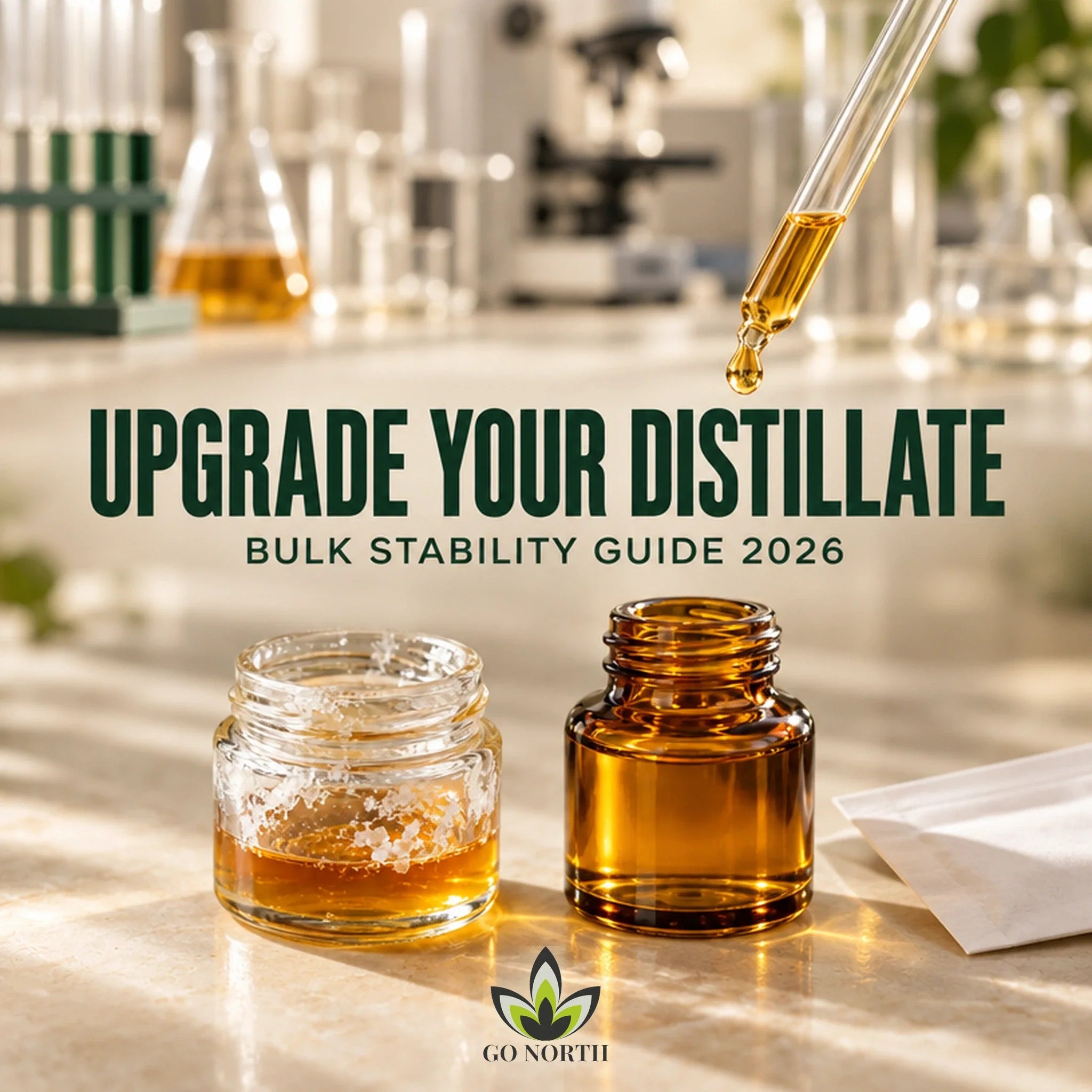

If your distillate keeps crystallizing, your COAs do not match reality, or your formulator keeps asking for one more fix, you are not dealing with bad luck. You are dealing with outdated hemp ingredients. Many brands still buy bulk distillates that worked in 2020 but cannot keep up with modern formulations: stable beverages, consistent carts, and shelf-stable edibles. This guide walks through the seven signs that it is time to upgrade, what each one costs you, and the crystal resistant distillate path that fixes them at the source.
Quick Answer: The seven signs are recurring crystallization, COA and label mismatches, off aromas, endless formulation fixes, supplier silence on state compliance, price-only competition, and a supplier with no next-generation ingredients. The fix is crystal resistant distillate (CRD): a stability-engineered cannabinoid that stays homogeneous in carts, beverages, and edibles through a full shelf life, with batch COAs from ISO/IEC 17025 accredited labs on every order.

The 7 Signs at a Glance
| Sign | What You See | Root Cause |
| 1. Crystallization | Product turns gritty or solid in the container | Unstable cannabinoid matrix |
| 2. COA mismatches | Labels say one thing, lab says another | Weak batch verification |
| 3. Off aromas | Distillate smells burnt, grassy, or chemical | Poor extraction and refinement |
| 4. Fix-after-fix formulation | Every batch needs a new workaround | Input instability passed downstream |
| 5. Compliance silence | Supplier dodges state rule questions | No documented THC totals |
| 6. Price-only positioning | The only argument is a lower number | Nothing else to offer |
| 7. No next-gen pipeline | Same SKUs as 2020, no CRD or water soluble | No formulation R&D |
1. Your Product Keeps Crystallizing
Crystallization is the clearest signal that a distillate is past its limit. Viscous cannabinoids start to separate and settle, carts clog, tinctures turn gritty, and beverages lose their emulsion. Every workaround, from reheating to re-mixing, treats the symptom while the ingredient stays the problem.
2. Your COAs Do Not Match the Labels
When the certificate says 92% and the product tests at 84%, your brand owns that gap the moment it reaches a retailer or a regulator. Batch-matched COAs from ISO/IEC 17025 accredited laboratories are the minimum standard; a supplier who cannot produce them is transferring their quality risk onto your label.

3. Your Distillate Smells Off
Quality distillate should read as clean and neutral. Burnt, grassy, or chemical aromas point to over-heated extraction, poor winterization, or residual impurities. Off aromas almost always predict off performance later in the product life cycle.
4. Your Formulator Keeps Adding Fixes
Every "just one more adjustment" is unbudgeted R&D spent compensating for an ingredient that was never engineered for your format. Stable inputs remove that loop: the formulation works the first time and keeps working on reorders.
5. Your Supplier Avoids State Compliance Conversations
The 2018 Farm Bill sets the federal frame, but states layer their own rules under the USDA hemp production program, and several have restricted intoxicating hemp products. A serious supplier documents total delta 9 THC on every batch and talks through your destination state without hesitation. Silence on this topic is a signal, not an oversight. See the 2026 Cannabinoid Buyer's Guide for Hemp Suppliers for the full vetting checklist.
6. You Are Competing on Price Alone
When a supplier's only argument is a lower number, the margin difference eventually appears somewhere: potency drift, batch inconsistency, missing documentation, or lead-time surprises. Cheap distillate that fails a batch costs more than premium distillate that ships clean.
7. You Do Not Know What Is Coming Next in Cannabinoids
Category leaders are already formulating with crystal resistant distillates, water soluble powders, and minor cannabinoids like CBC and THCV. If your supplier's catalog has not changed since 2020, your line is competing with yesterday's ingredients against brands that already upgraded.

The Upgrade Path: Crystal Resistant Distillate
If sign number one keeps coming back, the fix is not another workaround. It is a molecule engineered for stability. Crystal resistant distillate (CRD) stays homogeneous at scale, resists the crystallization that wrecks standard distillate formulations, and keeps carts, beverages, and tinctures consistent through their full shelf life.
Compare formulations in Crystal Resistant vs Standard Distillate: What Bulk Buyers Need to Know. See the spec sheet for bulk CBG Crystal Resistant Distillate, including COA documentation and wholesale pricing. For formulation teams, water soluble CBG solves the same stability problem in beverage and powder formats.
Every CRD order ships with batch specific COAs from ISO/IEC 17025 accredited laboratories, so sign number two never comes back either.
How to Switch Suppliers Without Stopping Production
1. Request batch COAs for the exact lot you would receive.
2. Run a small side-by-side trial in your existing formulation.
3. Compare stability at 2, 4, and 8 weeks against your current input.
4. Place a production order only after the trial numbers match the certificate.
To price the upgrade, create a business account in the wholesale portal for live quotes, or request a bulk quote and the team responds the same business day. Questions by phone: the wholesale portal.
Frequently Asked Questions
Why does my distillate crystallize?
Crystallization happens when the cannabinoid matrix is not engineered for long-term homogeneity, a stability problem well documented in published cannabinoid stability research. Minor cannabinoids and isolated compounds separate out of unstable matrices over time, especially in carts and tinctures. Crystal resistant distillate is formulated specifically to prevent it.
Why is my distillate dark?
Dark color usually traces back to over-heated extraction, oxidized feedstock, or incomplete refinement. Color drift is a quality signal worth investigating before the batch goes into production.
What is crystal resistant distillate?
CRD is a distillate formulated to stay homogeneous and resist crystallization through its shelf life, making it suitable for vaporizable products, beverages, and edibles where standard distillate separates.
Does CRD change my potency claims?
No. CRD carries batch-specific potency documentation from ISO/IEC 17025 accredited labs, so your label claims match the certificate exactly.
How do I test a new ingredient before committing?
Run a small side-by-side stability trial against your current input at 2, 4, and 8 weeks, comparing appearance, potency retention, and performance in your finished format.
Wholesale Platform
Ready to Upgrade Your Distillate?
Crystal resistant distillate is in stock with COA documentation on every batch. Create a business account for live wholesale pricing, or request a bulk quote.
Please check your local rules before purchasing. If you have questions, please consult a local representative.
Ready to future proof your supply chain?
Get instant access to trade pricing, live lot availability, and batch COAs on every order. Business verification unlocks preferred pricing for your account.