
Cart
0

✎ Key Takeaways
- Water soluble CBD uses nanoemulsion technology to achieve 3–4× higher oral bioavailability than oil-based formats, making it the preferred input for beverages, fast-acting tinctures, and sublingual products.
- B2B buyers should evaluate suppliers on concentration load (% CBD), stability data, carrier system transparency, and ISO/IEC 17025-accredited lab testing - not just price.
- Bulk water soluble CBD wholesale pricing typically ranges from $390–$950/kg depending on concentration, cannabinoid type, and order volume.
- Go North Hemp offers a full line of water soluble cannabinoids - CBD, CBG, CBN, THCP 20%, HD9, and Delta 8 - all COA-verified, MOQ 100g, UPS or Selected Transport Company worldwide shipping.
Related Beverage Formulation Resources
For a complete overview of beverage-ready cannabinoid systems, formulation variables, dosage, processing, and shelf-life requirements, review our Water Soluble Cannabinoids for Beverages guide .
The Formulation Problem Every Beverage and Tincture Brand Hits
You've locked in your product concept. The market research supports it. The contract manufacturer is on standby. Then your formulator delivers the hard truth: standard CBD oil doesn't mix into water-based products.
Oil and water don't blend. When you add a conventional CBD oil or distillate to an aqueous formula - a functional beverage, a water-based tincture, a fast-dissolve sublingual - the cannabinoid separates, floats, and delivers unpredictably. Your end consumer gets inconsistent dosing, visible oiliness, and reduced efficacy.
That's not a branding problem. It's a chemistry problem, and it has a well-established industrial solution: water soluble CBD, produced through nanoemulsion technology. This guide covers everything a B2B formulator, brand builder, or white-label product developer needs to know before placing a bulk order.
What Is Water Soluble CBD? How Nanoemulsion Works
Water soluble CBD is not a chemically altered version of cannabidiol. It is CBD - typically starting as a high-purity CBD isolate - that has been processed through nanoemulsification to reduce particle size and make it dispersible in aqueous systems.

Left: oil-based CBD separating in water. Right: nanoemulsified CBD dispersing evenly - showing the core formulation advantage of water soluble formats.
Here's the core science: CBD is inherently hydrophobic (oil-loving). In its natural state, it won't dissolve in water. Nanoemulsification breaks the CBD down into nano-sized droplets - typically 15 to 200 nanometers in diameter - and encapsulates those droplets in food-grade emulsifiers (such as sunflower lecithin or polysorbate derivatives). The resulting material disperses evenly in water-based formulations without separation.
The particle size matters enormously. Smaller droplets create exponentially greater surface area for intestinal absorption. Research published in Medical Cannabis and Cannabinoids found that CBD delivered via UltraShear nanoemulsion achieved bioavailability of 18.6% at 6 hours and 25.4% at 24 hours - roughly 3–4× the typical ceiling for oil-based oral CBD, which averages approximately 6% due to first-pass metabolism. A separate crossover clinical study published in the Journal of Cannabis Research confirmed significantly enhanced peak plasma concentration and faster onset with self-nanoemulsifying delivery systems compared to standard oil drops.
Key Technical Specifications to Know
- Concentration load: The percentage of active cannabinoid in the water soluble matrix (e.g., 20% CBD means 200mg CBD per gram of product).
- Particle size: Sub-200nm is standard; sub-100nm is premium. Smaller = better dispersion and absorption.
- Carrier system: Food-grade emulsifiers only. Ask your supplier what emulsifiers are used.
- Appearance: High-quality water soluble CBD should be clear to slightly milky in solution, not visibly separated.
- Shelf stability: Properly formulated nanoemulsions remain homogenous without refrigeration during the stated shelf life.
Why B2B Brands Choose Water Soluble Over Oil-Based CBD
The shift toward water soluble formats among professional formulators isn't a trend - it's driven by measurable performance advantages and market demand for specific product types. While CBD isolate and crystal resistant distillate (CRD) remain the dominant inputs for oil-based and lipid-soluble applications, water soluble formats unlock an entirely different product category.
1. Superior Bioavailability = Better Consumer Results
When your customer takes an oil-based CBD product orally, first-pass metabolism in the liver degrades a significant portion before it reaches systemic circulation. Nanoemulsified CBD largely bypasses this pathway, delivering more active compound per milligram. For your customers, that means faster onset, more predictable effects, and less wasted product.
For a detailed comparison between nanoemulsified cannabinoids and traditional formats, see our Nano CBD vs Water Soluble CBD for Beverages guide.2. Formulation Compatibility
Oil-based CBD simply cannot be incorporated into clear beverages, water-based serums, or fast-dissolve powders without causing separation, cloudiness, or layer stratification. Water soluble CBD integrates cleanly into aqueous systems without requiring additional emulsification work from your production team.
Brands developing beverage products should also review our How To Formulate Functional Beverages guide.3. Dosing Precision
Because nanoemulsified CBD remains evenly dispersed throughout a liquid, every unit of your finished product contains a consistent dose. Inconsistent dosing is a liability in the wellness and supplement space - both for regulatory purposes and customer trust.
For dosage planning and serving architecture, review our Cannabinoid Dosage In Beverages article.4. Sensory Profile
High-quality water soluble CBD is virtually tasteless and odorless in solution. This is essential for beverage formulators who need the cannabinoid input to be neutral, allowing their flavor profile to dominate.
5. Cost Efficiency at Scale
Higher bioavailability means you can use less CBD to achieve the same consumer-facing effect. At scale, lower inclusion rates translate directly into reduced COGS - a meaningful advantage when competing in a price-sensitive retail environment.
Key Use Cases: Where Water Soluble CBD Belongs in Your Line

Water soluble CBD dispersing cleanly during beverage formulation - the primary use case driving B2B demand for nano cannabinoid inputs.
Functional Beverages
This is the primary driver of water soluble cannabinoid demand. Energy drinks, relaxation shots, CBD waters, wellness sparkling beverages - all require a water-compatible cannabinoid input. Oil-based formats are not viable here. Water soluble CBD, water soluble CBN (for sleep), and water soluble CBG (for focus) are the standard inputs for this growing segment.
Fast-Acting Sublingual Tinctures
Sublingual delivery already benefits from bypassing first-pass metabolism. Pair that with a nanoemulsified cannabinoid, and you get faster onset and higher absorption efficiency than oil tinctures. Brands looking to compete on efficacy claims are increasingly switching to water soluble inputs for their sublingual line.
Dissolvable Powders and Stickpacks
Water soluble CBD powder forms dissolve instantly in cold or hot liquid, enabling on-the-go wellness formats. This category is growing rapidly in the supplement space, particularly for sleep, recovery, and stress management SKUs.
Water-Based Topicals and Serums
Aqueous-based skincare formulations - serums, gels, face mists - require water-compatible actives. Water soluble CBD allows clean integration into these systems without disrupting emulsion stability.
Capsules and Softgels (Water-Based Fills)
Some capsule technologies use aqueous fill systems. Water soluble cannabinoids integrate cleanly here and can improve bioavailability compared to oil-fill capsules in certain delivery architectures.
Looking to launch a finished product using water soluble cannabinoids? Go North Hemp's white label program covers oils, tinctures, topicals, capsules, and more - with the same batch-verified inputs from their bulk line.
What to Look for in a Water Soluble CBD Supplier
Sourcing water soluble cannabinoids at scale requires more rigorous vetting than standard isolates or distillates. The nanoemulsification process introduces additional variables - and additional points of failure - that don't exist with straight isolate procurement.
1. ISO/IEC 17025-Accredited Third-Party Lab Testing
This is non-negotiable. ISO/IEC 17025 accreditation is the international standard for testing laboratory competence. A COA from a non-accredited lab is not equivalent. Your supplier should provide batch-specific COAs from accredited, ideally DEA-registered labs covering:
- Cannabinoid potency (confirming concentration load)
- Residual solvents
- Heavy metals
- Microbials, mycotoxins, and pesticides
- Δ9-THC levels (compliance)
2. COA Transparency and Batch Traceability
Don't accept a single generic COA for a product line. Every batch you receive should have its own corresponding COA, with a batch ID you can verify. The best suppliers maintain a public COA database so you can audit testing history before placing an order - not just after it arrives.
Go North Hemp's COA Transparency Hub is exactly this kind of resource: a public, searchable database of 25+ batch COAs tested by DEA-registered, ISO-accredited labs including California Ag Labs and PharmLabs San Diego. Every product in their water soluble line has a live, batch-specific COA you can download before ordering.
3. Stated Concentration Load with Verification
A supplier who says "water soluble CBD" without specifying the concentration load (e.g., 20% CBD by weight) is not giving you the information you need to formulate accurately. Demand a stated, lab-verified concentration for every product you're evaluating.
4. Emulsifier Transparency
Ask what emulsifiers are used in the carrier system. Food-grade emulsifiers (lecithin, polysorbate derivatives, vitamin E TPGS) are acceptable for ingestible applications. Avoid suppliers who are vague about their emulsifier package - this information directly affects your finished product's regulatory labeling obligations.
5. Stability Data
Water soluble cannabinoid formulations can phase-separate or degrade over time if improperly manufactured. Ask your supplier for stability testing data covering the full stated shelf life at relevant temperature conditions. This protects you from receiving product that will fail in your finished goods.
6. cGMP Manufacturing Standards
Current Good Manufacturing Practices (cGMP) establish quality controls for manufacturing processes, equipment, and facilities. A cGMP-compliant supplier reduces contamination risk and ensures batch-to-batch consistency - critical for brands operating in regulated markets or positioning for retail shelf placement. Learn more about Go North Hemp's compliance standards and certifications.
7. Minimum Order Quantities, Scalability, and Shipping Speed
For B2B buyers, MOQ and lead time matter equally. You need a supplier who can serve you at your current volume, grow with you, and deliver without extended delays. Go North Hemp's MOQ starts at 100g - accessible for formulators in development stages - with volume pricing available as production scales and UPS or Selected Transport Company worldwide shipping on all orders.
Go North Hemp's Water Soluble Cannabinoid Line
Go North Hemp is a bulk cannabinoid supplier based in Tigard, Oregon, offering a full spectrum of water soluble cannabinoid inputs verified for B2B formulation. Their water soluble line includes:
| Product | Cannabinoid | Notes |
|---|---|---|
| Water Soluble CBD | Cannabidiol | 20% load, nano emulsion, THC ND, California Ag Labs verified |
| Water Soluble CBG | Cannabigerol | 24.7% load, nano, PharmLabs San Diego tested |
| Water Soluble CBN | Cannabinol | For sleep and relaxation formulations |
| Water Soluble THCP 20% | THCP | Rare cannabinoid, high-potency nano format |
| Water Soluble HD9 | Δ9-THC | 19.72% cannabinoid load, ISO/IEC 17025 Acc. #85368 |
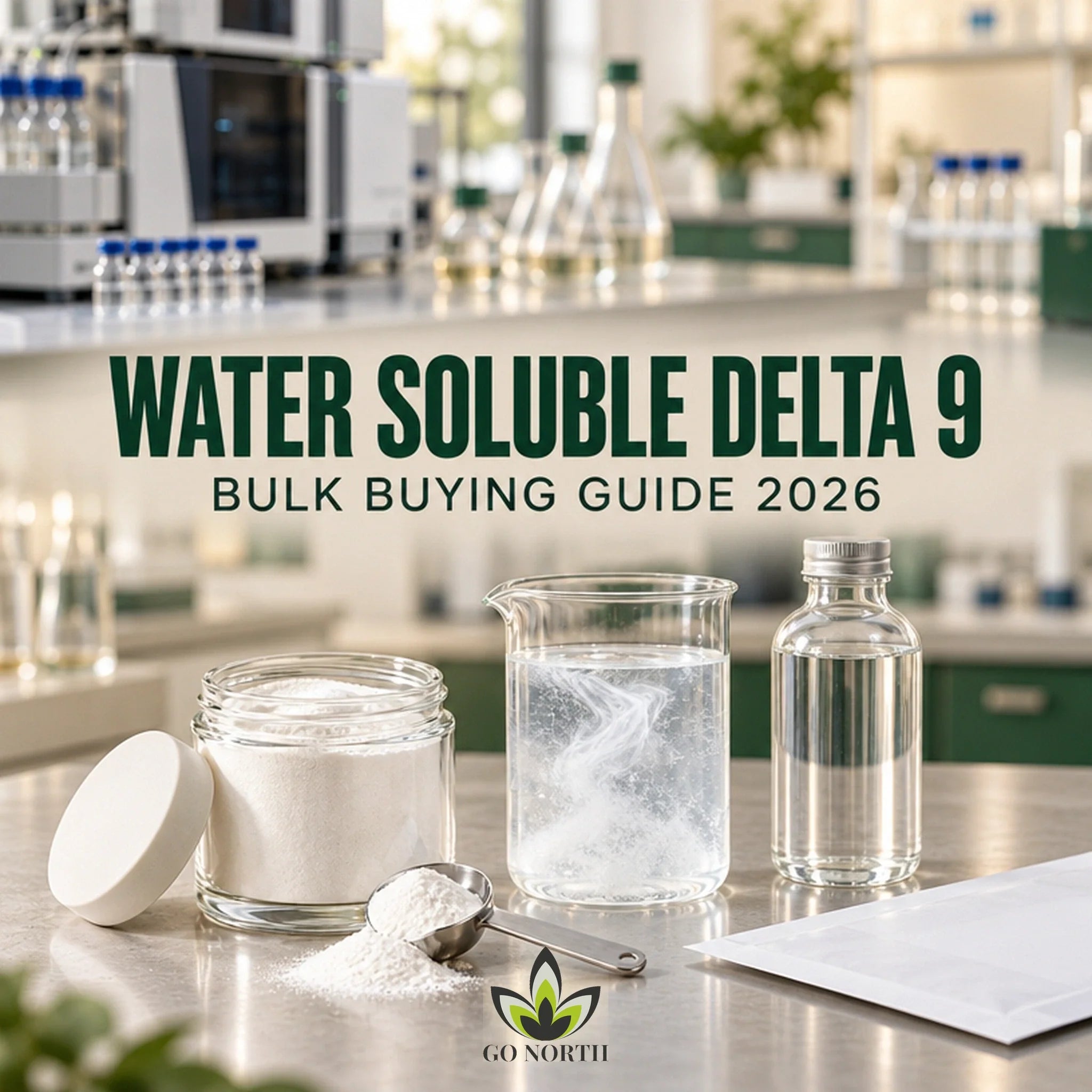
| Water Soluble Delta 8 | Δ8-THC | Available in liquid and powder forms |
All products are tested through DEA-registered, ISO-accredited labs. Full batch COAs are accessible through the COA Transparency Hub. Go North Hemp also offers white label hemp products for brands building finished goods at scale, covering oils, tinctures, topicals, capsules, and more.
Beyond water soluble formats, Go North Hemp supplies a full range of cannabinoid ingredients - including CBD isolate, CBG isolate, CBN isolate, and Crystal Resistant Distillate (CRD) - making them a single-source supplier for brands building multi-format product lines.
Bulk Water Soluble CBD Wholesale: 2026 Pricing Benchmarks

Go North Hemp supplies bulk water soluble cannabinoids in scalable quantities - from 100g development batches to kilogram-scale production orders, with UPS or Selected Transport Company worldwide shipping.
Water soluble CBD pricing varies significantly based on cannabinoid type, concentration load, particle size technology, and order volume. Here are current market reference ranges for B2B buyers:
| Cannabinoid | Concentration | Market Range (per kg) |
|---|---|---|
| Water Soluble CBD | 10–20% | $390–$950/kg |
| Water Soluble CBG | 20–25% | $650–$1,200/kg |
| Water Soluble CBN | 15–20% | $800–$1,500/kg |
| Water Soluble Delta 8 | 20%+ | $500–$950/kg |
Factors that affect price:
- Concentration load: Higher % CBD per gram = higher price per kg, but lower inclusion rate in your formula.
- Volume discounts: Most suppliers offer tiered pricing. Buying at 10kg+ typically unlocks meaningful savings versus 1kg minimums.
- Lab panel depth: Suppliers testing for the full suite (residual solvents, metals, microbials, mycotoxins, pesticides) may price slightly higher - but the risk reduction justifies the premium.
- Emulsifier quality: Premium food-grade carrier systems cost more to produce. Be cautious of pricing that seems implausibly low.
When evaluating quotes, compare on a cost-per-mg-of-active-cannabinoid basis, not just price per kilogram. A 20% load product at $800/kg delivers the same active ingredient as two kilograms of a 10% load product - pricing transparency matters here.
Unlike most bulk cannabinoid suppliers who hide pricing behind quote forms, Go North Hemp publishes pricing directly on their product pages - so you can benchmark before you ever pick up the phone.
How to Evaluate and Compare Water Soluble CBD Suppliers
Most B2B buyers are evaluating 3–5 suppliers simultaneously. Here's a practical scorecard to make the process systematic:
| Criteria | What to Ask | Red Flag |
|---|---|---|
| Lab accreditation | Is the lab ISO/IEC 17025 accredited and DEA-registered? | "Third-party tested" with no lab name |
| Batch-specific COAs | Is there a public COA database with batch IDs? | Single generic COA for all batches |
| Concentration load | What is the exact % cannabinoid by weight? | "Highly concentrated" with no number |
| Emulsifier disclosure | What emulsifiers are used? Food-grade? | "Proprietary blend" - no details |
| MOQ flexibility | Can you start at 100–500g for development? | $10,000 minimum first orders |
| Stability data | Do they have shelf-life testing at temperature? | No stability data available |
| Shipping speed | What is standard lead time and shipping method? | 3–6 week lead times, no express option |
| Pricing transparency | Is pricing listed publicly? | "Request a quote" with no benchmarks |
Go North Hemp checks every box in this table - public COA database, stated concentrations, disclosed emulsifiers, 100g MOQ, and published pricing. You can review their full FAQ page for sourcing and compliance questions before reaching out.
How to Evaluate a Water Soluble CBD Supplier
Choosing a water soluble CBD supplier is not just about comparing price per kilogram. For beverage brands, the most important question is whether the ingredient can perform consistently in the finished product. Before committing to a supplier, brands should evaluate particle size, shelf-life data, flavor impact, formulation support, and true commercial cost per serving.
1. Ask About Particle Size Distribution
Particle size can influence clarity, dispersion, mouthfeel, bioavailability, and long-term stability. Instead of only asking whether an ingredient is “nano” or “water soluble,” ask for the actual particle size distribution of the emulsion.
Important details may include:
- D50 particle size
- D90 particle size
- Testing method used
- Whether the emulsion remains consistent over time
- How particle size performs in the target beverage system
This helps separate marketing language from measurable formulation performance.
2. Request Shelf-Life Data at Your Target pH and Packaging Format
A water soluble CBD ingredient should be evaluated in conditions that match the actual beverage. Stability in a neutral lab sample does not automatically mean the ingredient will perform the same way in an acidic sparkling beverage, functional shot, tea, juice, or canned ready-to-drink product.
Brands should ask whether the supplier has shelf-life data for:
- The target pH range
- Carbonated or non-carbonated formats
- Glass, aluminum can, PET, or other packaging formats
- Ambient, refrigerated, and accelerated storage conditions
- Potency, clarity, flavor, and visual stability over time
3. Ask for 30, 60, and 90+ Day Beverage Stability Studies
For commercial beverage development, short-term bench testing is not enough. Brands should ask whether the supplier can provide beverage-specific stability studies that show how the ingredient performs over time.
Useful stability data may include:
- 30-day stability results
- 60-day stability results
- 90-day or longer stability results
- Potency retention data
- Visual separation, sediment, or ring formation observations
- Performance under heat, light, and storage stress
This is especially important for brands planning retail distribution, wholesale expansion, or inventory storage.
4. Evaluate Flavor Impact at the Intended Dosage
CBD ingredients can affect flavor, aroma, bitterness, and mouthfeel. The impact may change depending on dosage, sweetener system, acidity, carbonation, botanical ingredients, and flavor profile.
Instead of testing the ingredient only in water, evaluate it at the intended commercial dosage inside the actual beverage formula. This helps determine whether additional flavor masking, sweetener adjustment, acid balancing, or formulation support will be needed.
5. Confirm Formulation Support and Beverage-Specific Technical Assistance
The right supplier should be able to support more than ingredient delivery. Beverage brands often need help with bench formulation, dosage calculations, ingredient compatibility, stability troubleshooting, flavor impact, and co-manufacturer communication.
Before choosing a supplier, ask whether they can assist with:
- Formula development
- Dosage and serving-size planning
- Ingredient compatibility reviews
- Stability troubleshooting
- COA and documentation support
- Scaling from pilot batches to commercial production
6. Compare Cost Per Delivered Milligram, Not Just Cost Per Kilogram
Ingredient pricing should be evaluated based on the cost per delivered milligram of CBD in the finished beverage. A lower-cost ingredient may become more expensive if it requires higher usage rates, causes potency loss, creates flavor-masking costs, or fails stability testing.
For a better commercial comparison, brands should consider:
- Cost per kilogram
- CBD concentration
- Target milligrams per serving
- Potency retention over shelf life
- Additional formulation or flavor-masking costs
- Manufacturing efficiency at scale
The best supplier is not always the cheapest supplier. The best supplier is the one that helps deliver a stable, compliant, consumer-ready beverage at a commercially viable cost.
Water Soluble CBD Buyer Checklist
- ✓ Request a batch-specific COA
- ✓ Verify THC compliance status
- ✓ Confirm cannabinoid concentration load
- ✓ Review stability testing data
- ✓ Verify cGMP manufacturing standards
- ✓ Confirm MOQ requirements
- ✓ Review lead times and shipping options
- ✓ Evaluate cost per mg of active cannabinoid
Completing this checklist before placing an order can help beverage brands avoid costly formulation and supply chain issues.
Frequently Asked Questions
Q: What is the difference between water soluble CBD and CBD nanoemulsion?
These terms are often used interchangeably. Nanoemulsion describes the production technology; water soluble CBD describes the resulting product characteristic. All water soluble CBD is produced via some form of nanoemulsification - the key variable is particle size, emulsifier type, and concentration load.
Q: Can water soluble CBD be used in hot beverages?
Yes, with caveats. Most nanoemulsion formulations are stable at pasteurization temperatures (up to ~85°C for brief periods), but sustained high heat can degrade emulsion stability. For hot beverage applications (tea, coffee), ask your supplier for heat stability data specific to their formulation before committing to bulk quantities.
Q: How do I calculate inclusion rate for my beverage formula?
Determine your target CBD dose per serving (e.g., 25mg CBD per 12oz can). Then divide by your water soluble product's concentration load. For a 20% load water soluble CBD: 25mg ÷ 0.20 = 125mg of water soluble product per serving. At scale, this translates to a predictable COGS input.
Q: Is water soluble CBD THC-free?
It depends on the source material. Water soluble CBD derived from CBD isolate is THC-free (ND on COA). Water soluble products derived from broad-spectrum or full-spectrum extracts may contain trace THC. Always verify THC status on the specific batch COA - not just the product description. Go North Hemp's Water Soluble CBD (20% load) shows Δ9-THC: ND on its California Ag Labs COA, verified through the COA Transparency Hub.
Q: What certifications should my water soluble CBD supplier have?
At minimum: ISO/IEC 17025-accredited third-party lab testing for all batches, and cGMP manufacturing compliance. DEA-registered labs add an additional layer of regulatory credibility. For brands targeting retail chains or supplement distributors, cGMP documentation may be required at the buyer level. See how Go North Hemp meets these standards on their About page.
Q: What's the difference between water soluble CBD and water soluble CBN or CBG?
The carrier technology is the same - nanoemulsification - but the active cannabinoid and its applications differ. Water soluble CBN is primarily used in sleep and relaxation formulations. Water soluble CBG is gaining traction in focus, gut health, and energy beverage applications. Sourcing all three from a single supplier simplifies COA management and logistics.
Ready to Source Water Soluble Cannabinoids at Scale?
Go North Hemp offers a complete line of B2B-ready water soluble cannabinoids with COA-verified purity, ISO/IEC 17025-accredited testing, cGMP-aligned manufacturing, and scalable MOQs starting at 100g. Orders ship worldwide via UPS or Selected Transport Company.
Browse Water Soluble Line → Explore White Label →Ready to future proof your supply chain?
Visit the COA Hub or contact the Ingredient Team to start your 2026 formulations.
Call 971-406-3862 for trade pricing and live lot availability.
Sourcing Water-Soluble Cannabinoids?
Create your Go North Hemp business account to access wholesale pricing and streamlined ordering on our wholesale platform.
Shop Wholesale