
Cart
0
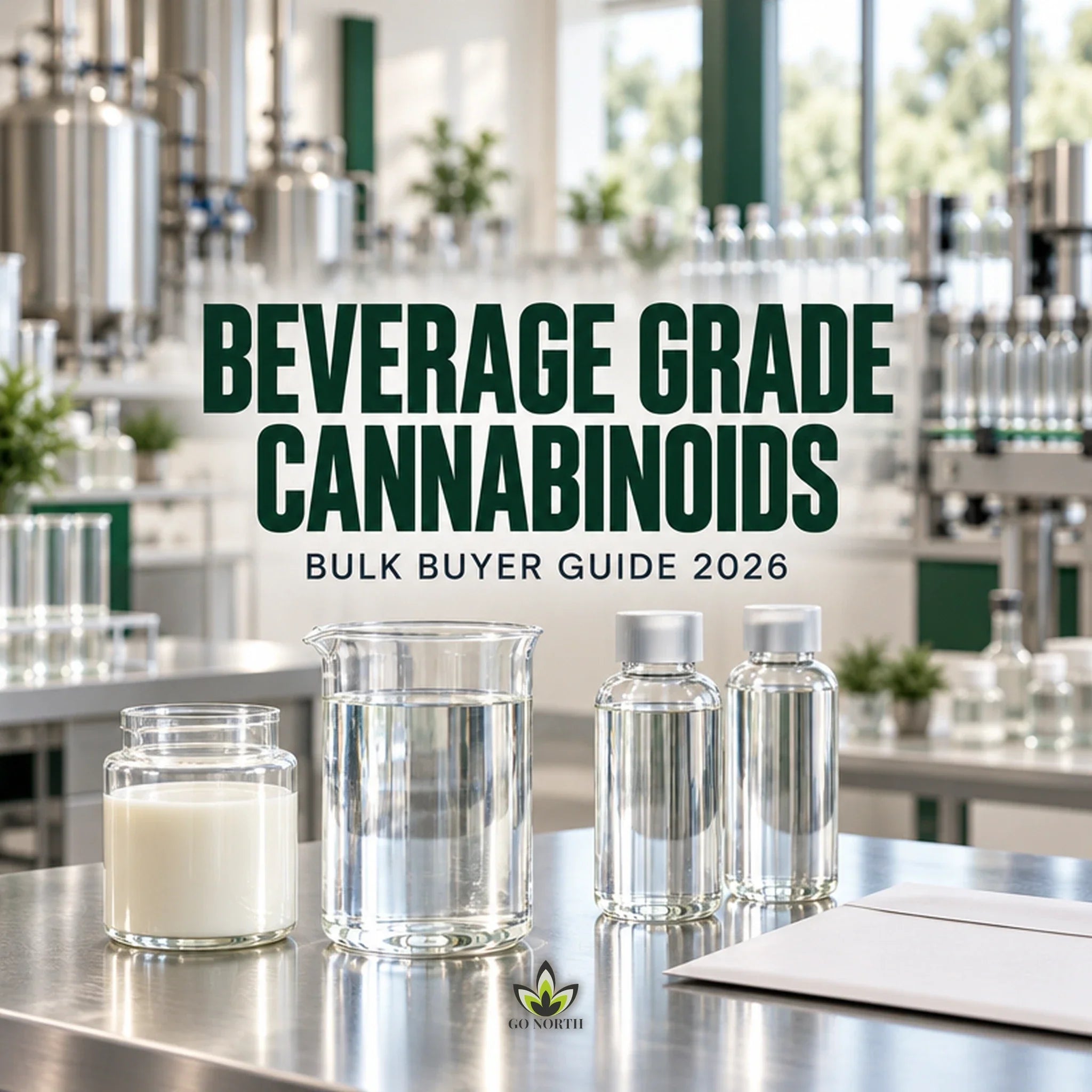

Beverage Grade Cannabinoids Buyer Guide: Bulk Specs, Pricing and Sourcing
Quick Answer
Buying beverage grade cannabinoids in bulk means sourcing water compatible ingredients with lot-specific COAs, beverage-relevant micro testing, documented emulsion stability, and volume-based pricing. Water soluble formats are the standard for ready-to-drink products. Verify every lot on a full-panel COA before committing to production.
For beverage brands, sourcing cannabinoids is not the same as sourcing raw distillate. A ready-to-drink product needs an ingredient that disperses cleanly, survives pasteurization or hot-fill where applicable, holds potency through the declared shelf life, and passes finished-product testing in your destination market. This buyer guide covers what to buy, what the spec sheet should show, how bulk pricing is structured, and how to move from pilot batch to production scale. If you are still shortlisting suppliers, pair this with our Beverage Grade Cannabinoids Supplier Guide, and review our beverage ingredient pillar page for the full program.
What Beverage Brands Actually Buy
Ready-to-drink, water-based products commonly use water-dispersible cannabinoid formulations, with nano emulsions one widely used approach among several validated dispersion systems. Oil-based distillates remain useful for lipid carriers and tincture-style beverages, but for seltzers, teas, and functional sodas, a water-dispersible ingredient is the common starting point. Water dispersibility is not proof of complete molecular dissolution: validate pH tolerance, clarity or turbidity targets, processing temperature, ingredient compatibility, dose uniformity, and stability in your actual beverage. Go North Hemp offers water soluble formats across major actives, subject to current availability and lot documentation, including Water Soluble HD9, Water Soluble Delta 8, and Water Soluble THCP.
Match the active to your product concept before comparing prices. Our Delta 9 beverage formulation guide and cannabinoid dosage in beverages guide cover active selection and per-serving dosing in depth.

Beverage Grade Specifications to Request
A credible beverage grade ingredient ships with a technical spec sheet and a lot-specific COA. These are the parameters that matter for beverage production:
| Parameter | What to Verify | Why It Matters for Beverages |
|---|---|---|
| Cannabinoid potency | HPLC verified, mg per mL or mg per gram | Drives per-serving dosing math and label accuracy |
| Particle size distribution | D50 and D90 measurements where relevant, with method and storage behavior | A characterization input; does not by itself establish clarity, stability, or onset, so require independent evidence for any absorption claim |
| Micro panel | Total plate count, yeast and mold, enterobacteriaceae | Beverage production environments demand micro discipline |
| Heavy metals | Lead, arsenic, cadmium, mercury below your jurisdiction action limits | Finished-beverage requirements are jurisdiction-specific; confirm your destination market testing |
| Residual solvents | Process-relevant panel with reporting limits | Confirms refinement quality |
| Delta-9 THC | At or below 0.3% dry weight, hemp derived | Baseline Farm Bill positioning for the ingredient |
| Emulsion stability | Accelerated and real-time stability data | Protects your declared shelf life |
Never accept a generic beverage grade label in place of lot data. Verify the lot number on the COA against your packaging, and confirm the lab holds ISO/IEC 17025 accreditation covering the relevant testing activities. Keep the lot COA separate from technical performance documents: emulsion stability, thermal processing compatibility, particle-size behavior, and finished-beverage shelf life require validation beyond a routine potency COA. Our COA Hub makes lot verification public before you commit.

How Bulk Beverage Cannabinoid Pricing Works
Bulk cannabinoid pricing for beverages is volume based, and three variables dominate the quote: the active itself (established actives like CBD sit at a different price point than novel actives), the format (nano emulsions carry processing cost over raw distillate), and the order size. Most suppliers, including Go North Hemp, quote in tiers from research quantities through kilogram-scale production volumes.
The practical approach for a new beverage brand:
1. Order a research or pilot quantity and validate performance in your actual beverage matrix, not just water.
2. Lock the formulation, then request production-volume pricing for your forecast volume.
3. Confirm the lot documentation package ships with every production batch, not only the sample.
Compare quotes on cost per tested milligram of target cannabinoid, not price per kilogram of ingredient: a 1 kg water-dispersible ingredient containing a low percentage of active cannabinoid is not directly comparable to 1 kg of high-potency distillate. Carrier content, formulation loading, and the assay on the lot COA drive the real number. Budget for finished-product testing as a separate line item. Ingredient COAs cover the input; your beverage still needs its own potency and stability testing before launch. For current pricing, request a quote through the wholesale portal or review the bulk cannabinoid ingredients overview. For a walkthrough of the cost structure across formats, see our beverage shelf stability guide.

Stability and Shelf Life Expectations
Ingredient shelf life follows the manufacturer documented storage and retest guidance for the specific product and lot, which is distinct from finished-beverage shelf life: that depends on formulation, packaging, processing, and storage conditions and must be validated in the drink itself. What matters more for your launch is stability in the finished beverage. Ringing, separation, and potency drift are the failure modes. Request real-time and accelerated stability data for the ingredient, then run your own beverage stability protocol at your declared shelf life before scaling. Nano emulsion behavior differs by matrix, acidity, and packaging, which is why validation in your own formula is non-negotiable.
Ordering, Logistics, and Scale-Up
The Go North Hemp wholesale path is built for beverage programs: create a business account at the wholesale portal for live pricing, or request a bulk quote with your volume and target active. Pilot and research minimums let you test before committing, subject to the wholesale team sample policy, and volume tiers scale to kilogram quantities for production runs. Fulfillment is limited to legally eligible destinations, subject to product classification, payment, available inventory, applicable law, carrier acceptance, and required documentation; orders ship via UPS or Selected Transport Company where eligible. Brands planning to outsource production can also explore white label beverage manufacturing with beverage-grade inputs included.
Federal Compliance: Beverage Cannabinoids in 2026
Federal treatment of a cannabinoid beverage program spans two separate questions: the hemp classification of the ingredient and the regulatory status of the finished drink.
The ingredient. The 2018 Farm Bill baseline covers hemp-derived extracts with no more than 0.3% delta-9 THC on a dry-weight basis. Federal amendments enacted in November 2025 take effect in stages: on November 12, 2026, certain intermediate and final hemp-derived cannabinoid products are excluded from the hemp definition, and on December 11, 2026, additional provisions take effect, including a revised total-THC standard and a 0.4 mg per container threshold for certain final products. Concentrated ingredients used in beverage production may fall under intermediate-product provisions, so verify the classification of your specific ingredient at your transaction date.
The finished beverage. Hemp classification does not authorize a finished beverage. FDA requirements govern food and beverage products, and permissible serving limits, labeling, safety substantiation, and claims require jurisdiction- and product-specific review. Different cannabinoids require their own safety and regulatory assessment; CBD and THC-specific food restrictions do not map identically onto every cannabinoid. State and destination-market rules add further layers.
A certificate of analysis documents analytical findings; it is not legal authorization. Confirm current federal law, state restrictions, and destination eligibility with qualified regulatory counsel before commercializing any cannabinoid beverage. This guide is general commercial information, not legal advice.
Frequently Asked Questions
Do I need water soluble cannabinoids for a beverage?
For ready-to-drink, water-based products, a water-dispersible system is the common approach, and nano emulsions are one widely used option among several. Oil-based distillates separate and ring in water matrices. Whatever system you choose must be validated in your intended beverage matrix.
What is the minimum order for beverage grade cannabinoids?
Research and pilot quantities are available for formulation testing, with volume tiers scaling to kilogram production orders. Request a quote with your target active and volume for current pricing.
How should I set the cannabinoid dose per serving?
There is no universal serving dose. Ingredient loading is calculated from the lot assay and your target formulation, and permissible serving limits, labeling, safety substantiation, and proposed claims require jurisdiction- and product-specific review before launch. Our cannabinoid dosage in beverages guide covers the framework.
What testing should I demand on a beverage cannabinoid COA?
Full panel: HPLC potency, micro testing, heavy metals, pesticides, and residual solvents, from an ISO 17025 accredited lab, matched to your lot number. For beverages, the micro panel is as important as potency.
How long do water soluble cannabinoids last?
Ingredient shelf life is set by the manufacturer documented storage and retest guidance for the specific product and lot, and finished-beverage shelf life depends on formulation, packaging, processing, and storage. Validate stability in your finished beverage at your declared shelf life.
Can I put regular distillate in a beverage?
No. Raw distillate is lipid soluble and will separate in water-based products. Beverage formulation requires a nano emulsion or another water compatible delivery system.
Are beverage grade cannabinoids Farm Bill compliant?
Hemp-derived ingredients with delta-9 THC at or below 0.3% dry weight align with the 2018 Farm Bill framework, but beverage legality varies by state and destination market. Review your destination rules before launch and keep ingredient COAs on file.
How do I verify a nano emulsion actually works?
Review particle size distribution data, request accelerated and real-time stability results, then run a pilot in your own beverage matrix. Clarity and dispersion in your actual formula tell you more than any spec sheet.
What is the difference between beverage grade and regular cannabinoids?
Beverage grade means water compatible, micro tested, and stability documented for drink matrices. Regular distillates and isolates are built for oils, edibles, and vapes, not water-based products.
Where can I buy beverage grade cannabinoids in bulk?
Go North Hemp supplies water soluble CBD, Delta 8, HD9, and THCP with lot-specific COAs and volume pricing through the wholesale portal, or call 971-406-3862 for a bulk quote.
Ready to Order Wholesale?
Pilot-friendly minimums, COA on every batch, fulfillment limited to legally eligible destinations via UPS or Selected Transport Company. Create a business account for live wholesale pricing, or request a bulk quote.
Questions? Call 971-406-3862.
Ready to future proof your supply chain?
Visit the COA Hub or contact the Ingredient Team to start your 2026 formulations.
Call 971-406-3862
for trade pricing and live lot availability.