
Cart
0
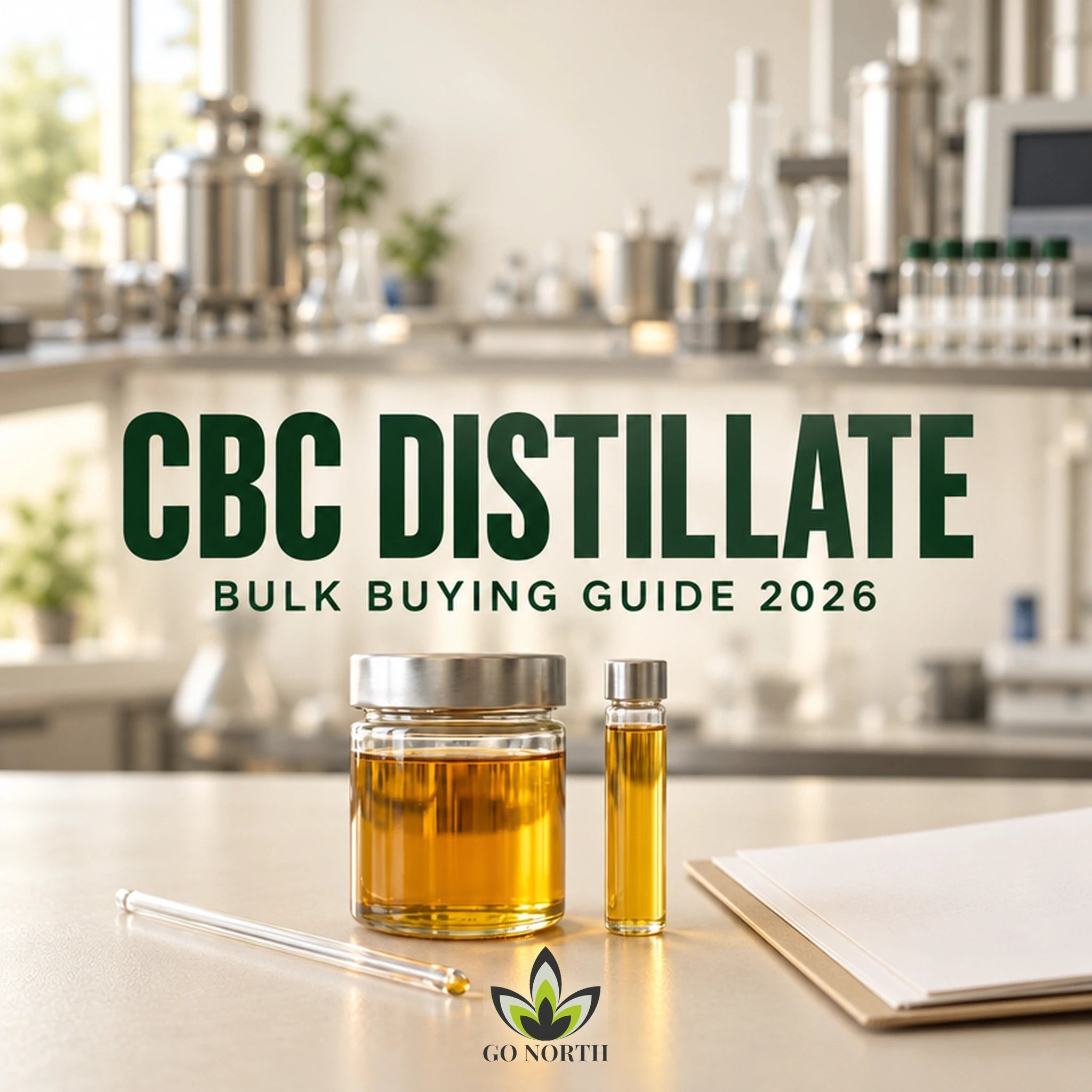

CBC Distillate Bulk Buying Guide: Sourcing, Specs, and Pricing for 2026
CBC, or cannabichromene, is quietly becoming one of the most requested minor cannabinoids in commercial formulation. As the entourage-effect market matures, formulators are moving beyond CBD-only products and building blends that pair major cannabinoids with minors like CBC, CBN, and CBG. If you are evaluating CBC distillate for tinctures, softgels, gummies, or topical lines, this guide covers what it is, what to verify before buying, and how bulk sourcing actually works.
CBC has been studied since the 1970s but has only recently become reliably available at commercial scale. That combination of research history and supply novelty means buyer education matters more here than in mature categories like CBD isolate.
What Is CBC Distillate?
CBC distillate is a refined oil in which cannabichromene has been concentrated from hemp extract into a potent, formulation-ready ingredient. Quality CBC distillate is a golden, viscous oil with a smooth consistency and mild flavor, making it easy to blend into carriers and finished products without fighting the ingredient.

CBC forms in the hemp plant from cannabigerolic acid (CBGA), the same parent molecule that produces CBD and THC. Unlike THC, CBC is generally described as non-intoxicating on current evidence, though the effects of any multi-cannabinoid finished product depend on its complete formulation. Unlike CBD, CBC's commercial story is entourage positioning: it is most often purchased to combine with other cannabinoids rather than to feature alone.
CBC shares the federal framework that governs other hemp-derived ingredients. Under the 2018 Farm Bill baseline, hemp extracts with 0.3% or less delta-9 THC on a dry weight basis remain the operative federal standard until the amended hemp definition takes effect in stages on November 12 and December 11, 2026, and a concentrated ingredient's lawful classification also depends on its presentation, intended use, and destination. Review the compliance section below and confirm the framework in force at your transaction date with your own counsel.
Why Formulators Are Buying CBC
Commercial interest in CBC clusters around a few use cases:
Entourage-effect blends. The most common application. Formulators combine CBC with CBD, CBN, or CBG to position products as full-spectrum or broad-spectrum experiences rather than single-molecule commodities.
Topical and skincare lines. CBC appears in a growing number of premium skincare formulations, and early research interest in cannabinoids for skin applications has pulled ingredient demand along with it.
Product differentiation. In a crowded cannabinoid market, a CBC-forward product stands out as early-mover rather than me-too. Brands building on less saturated minor cannabinoids face less direct comparison shopping on price.
Portfolio breadth. Multi-cannabinoid brands prefer suppliers who stock the full minor cannabinoid range, from distillates to isolates, so production planning consolidates and documentation standardizes under one vendor.
CBC Distillate Specifications: What Good Material Looks Like
When you evaluate CBC distillate, the specification sheet should cover at minimum:

| Spec | What to Look For |
|---|---|
| Appearance | Golden, translucent, viscous oil |
| CBC potency | Stated percentage backed by HPLC on the COA; verify the actual lot assay rather than assuming identical profiles across lots |
| Delta-9 THC | At or below 0.3% under the 2018 Farm Bill baseline; review the amended total-THC standard in force at your transaction date |
| Residual solvents | Below action thresholds on third-party testing |
| Pesticides and heavy metals | Pass, with full panel on the COA |
| Lot documentation | COA lot matches your physical containers |
CBC is a minor cannabinoid, which means extraction economics differ from CBD. Less CBC exists in the plant per unit of biomass, so refining to high potency is more demanding. That is exactly why provenance and testing matter more here: the category has fewer mature suppliers, and the documentation gap between good and bad vendors is wider.
Every lot of CBC distillate we ship carries third-party COA documentation from ISO/IEC 17025-accredited laboratories, and our COA Hub keeps batch records organized and accessible for your compliance files. Check that the laboratory's accreditation scope covers the testing performed, and review the reported detection limits rather than treating non-detect results as guarantees.
Federal Compliance: The 2026 Framework for CBC
The November 2025 federal amendments to the hemp definition take effect in two stages, confirmed by the September 28, 2026 Congressional Research Service analysis. On November 12, 2026, certain intermediate and final products containing cannabinoids incapable of being naturally produced by cannabis are excluded from the hemp definition. On December 11, 2026, the remaining provisions take effect: a revised total-THC standard that accounts for THCA, exclusions for certain intermediate products containing more than 0.3% combined total THC and cannabinoids with similar effects, and a 0.4 mg per container threshold for certain final products.
CBC occurs naturally in cannabis, but natural origin alone does not automatically establish the lawful classification of a concentrated bulk ingredient; a CBC distillate may fall within the statutory definition of an intermediate product, depending on its presentation and intended use. Until the amended dates, the 2018 Farm Bill framework, with 0.3% or less delta-9 THC on a dry weight basis, remains the operative federal baseline. State restrictions vary, so verify destination rules before shipping, and note that the FDA regulates intended finished-product categories separately. A batch COA is documentation, not legal authorization. This is not legal advice: confirm your transaction with regulatory counsel.
Bulk Sizing and Pricing Structure
CBC distillate is sold by weight, and pricing steps down as volume rises. A typical commercial ladder:

10g and 25g: formulation testing and sample validation sizes. Buy here first, run your own assay, and confirm the ingredient behaves in your carrier system.
50g and 100g: pilot batch territory. Small production runs, stability testing, and shelf-life validation.
250g and 500g: first commercial production volume. This is where unit economics start to stabilize.
1kg and up: production scale. At this tier you should be negotiating standing supply terms rather than spot pricing, including reserved inventory if your production calendar is fixed.
Current direct pricing on the CBC distillate product listing, checked October 13, 2026: 10g $339.40 ($33.94/g), 25g $522.15 ($20.89/g), 50g $803.30 ($16.07/g), 100g $1,235.85 ($12.36/g), 250g $1,901.25 ($7.61/g), 500g $2,925 ($5.85/g), and 1kg $4,500 ($4.50/g). Confirm pricing, stock, taxes, freight, and quoted volume terms with the ingredient team before purchasing, and treat listed prices as subject to lot confirmation.
The same ladder logic applies across our full ingredient range, from CBC to the broader bulk cannabinoid catalog. If CBC is one input in a multi-cannabinoid formulation, consolidate the buy: one supplier across your ingredient list means one documentation standard and one freight relationship.
How to Evaluate a CBC Supplier
Ask for lot-specific COAs before you ask for price. A supplier's willingness to hand over full third-party documentation, including potency, solvents, pesticides, and heavy metals, tells you more than their sales deck.
Verify the extraction story in writing. CBC production pathways vary by supplier and lot, and the regulatory treatment of naturally produced versus synthesized cannabinoids is changing under the amended federal framework. Ask for the supplier's process documentation for the specific lot and confirm how your material was produced before making origin claims of your own.
Test the sample yourself. Run an independent assay on the sample size you purchase. Reputable suppliers expect this. Suppliers who resist it are telling you something.
Confirm fulfillment capability. Lead times, packaging specs, lot labeling, and shipping matter as much as potency once you are in production. Concentrates ship in food-grade packaging with lot-matched documentation, and orders ship via UPS or Selected Transport Company only to approved or otherwise legally permitted destinations, subject to current law, available inventory, payment, carrier acceptance, and documentation.
Formulation Notes for Production Teams
CBC distillate generally integrates into oil-based carriers, but blending behavior and flavor are lot- and formulation-dependent, so confirm compatibility, homogeneity, potency retention, and stability in your own system for tinctures, softgels, gummies, and topicals. Standard practices: keep it away from light and heat during storage, decarb confirmation on the COA if your product requires active CBC rather than its acidic precursor, and homogeneity testing in gummies and softgels where cannabinoid distribution must be uniform per unit.
For teams building water-based products, a nano-emulsion system is one possible approach, subject to dispersion, potency uniformity, and stability validation; ask your supplier about water soluble availability or work with an emulsion partner before committing to beverage timelines.
Frequently Asked Questions
What is CBC distillate?
CBC distillate is a refined hemp extract in which cannabichromene has been concentrated into a potent, golden, formulation-ready oil. It is non-intoxicating and is primarily used in entourage-effect blends, topicals, and differentiated cannabinoid product lines.
Is CBC distillate legal?
Under the 2018 Farm Bill baseline, CBC from hemp with 0.3% or less delta-9 THC is federally permitted, but the November 2025 amendments change the framework in stages on November 12 and December 11, 2026, and a concentrated ingredient's classification depends on its presentation and intended use. Verify state rules and confirm your transaction with counsel; a supplier COA is documentation, not legal authorization.
Will CBC get me high?
CBC is generally described as non-intoxicating and does not produce the psychoactive effects associated with THC on current evidence. The effects of a multi-cannabinoid finished product depend on its complete formulation, so any positioning or claims you make still require substantiation.
What is the difference between CBC and CBD?
Both are non-intoxicating hemp cannabinoids, but they are different molecules with different research histories and market positions. CBD is a mature commodity category. CBC is a minor cannabinoid most often purchased to combine with other cannabinoids in entourage-effect or full-spectrum formulations.
What is the entourage effect?
The entourage effect is the hypothesis that cannabinoids work better together than in isolation. It is the commercial logic behind multi-cannabinoid blends: CBC plus CBD plus CBN, for example, positioned as a fuller-spectrum experience than any single molecule alone.
What sizes can I buy CBC distillate in?
Commercial CBC distillate is typically sold from 10 gram samples through 1 kilogram and larger production volumes. Sample first, validate in formulation, then scale with tiered volume pricing.
How much does CBC distillate cost per kilogram?
Current published pricing runs from $339.40 for a 10g sample to $4,500 per kilogram at the 1kg tier, checked October 13, 2026 against the live product listing, with per-gram costs falling significantly as order size rises. Confirm pricing, stock, taxes, freight, and quoted volume terms before purchasing.
What should a CBC distillate COA show?
A compliant COA shows the lot number matching your order, CBC potency by HPLC with reporting limits stated, delta-9 THC at or below 0.3% under the current baseline, residual solvent results, pesticide panel, and heavy metals screening, from a third-party lab whose ISO/IEC 17025 accreditation scope covers the testing performed. A COA is documentation, not legal authorization.
Can CBC distillate be used in beverages?
Oil-based CBC distillate is not water-soluble on its own; a nano-emulsion system is one possible approach, subject to dispersion, potency uniformity, and stability validation. Formulators building beverages should evaluate water soluble cannabinoid systems or work with an emulsion partner before committing to production timelines.
How do I store CBC distillate?
Store sealed, away from light and heat. Some suppliers recommend refrigerated or frozen storage for long-term inventory, but potency retention is lot-specific: confirm storage specs and stability expectations with your supplier and rotate lot stock using received dates.
Can I sample CBC distillate before buying bulk?
Yes, and you should. Reputable suppliers sell 10g to 25g sample sizes for formulation testing and independent assay. Validate the material in your own process before committing to production volumes.
How do I know my CBC is naturally extracted?
Ask the supplier directly and get the answer in writing for the specific lot. CBC production pathways vary: some material is refined from hemp biomass and some is produced through conversion processes, and the two carry different regulatory exposure under the amended framework. Base any origin claim on the supplier's documented process rather than on category assumptions.
Start Your CBC Buy With Documentation First
CBC is a premium minor cannabinoid with real formulation upside, and it rewards buyers who lead with documentation. Define your blend target, sample and assay before scaling, and consolidate your minor cannabinoid sourcing with a supplier who can document every lot.
Go North Hemp supplies CBC distillate with third-party COA documentation on every lot, alongside the full range of minor cannabinoid ingredients. Start with a 10g evaluation sample on the CBC distillate product page, pull current-lot documentation from the COA Hub, and compare across the bulk cannabinoid catalog; then create a business account on our wholesale portal or call 971-406-3862 for current tiered pricing.