
Cart
0
THC Oil Bulk Buying Guide: Hemp-Derived THC Oil for Wholesale Buyers

Hemp-derived THC oil has become one of the most requested bulk ingredients in the 2026 cannabinoid market. Search demand for THC oil keeps climbing, but most of what ranks for it is retail shops selling small bottles to consumers. This guide is written for the other side of the market: formulators, brand owners, and manufacturers sourcing hemp-derived THC oil in bulk, who need to know what the ingredient is, what the law actually allows, which specs separate good oil from bad, and how to vet a wholesale supplier before committing to production volume.
Go North Hemp supplies bulk cannabinoid ingredients to brands and manufacturers, and this guide reflects how professional buyers actually evaluate THC oil before ordering.
What Is Hemp-Derived THC Oil?
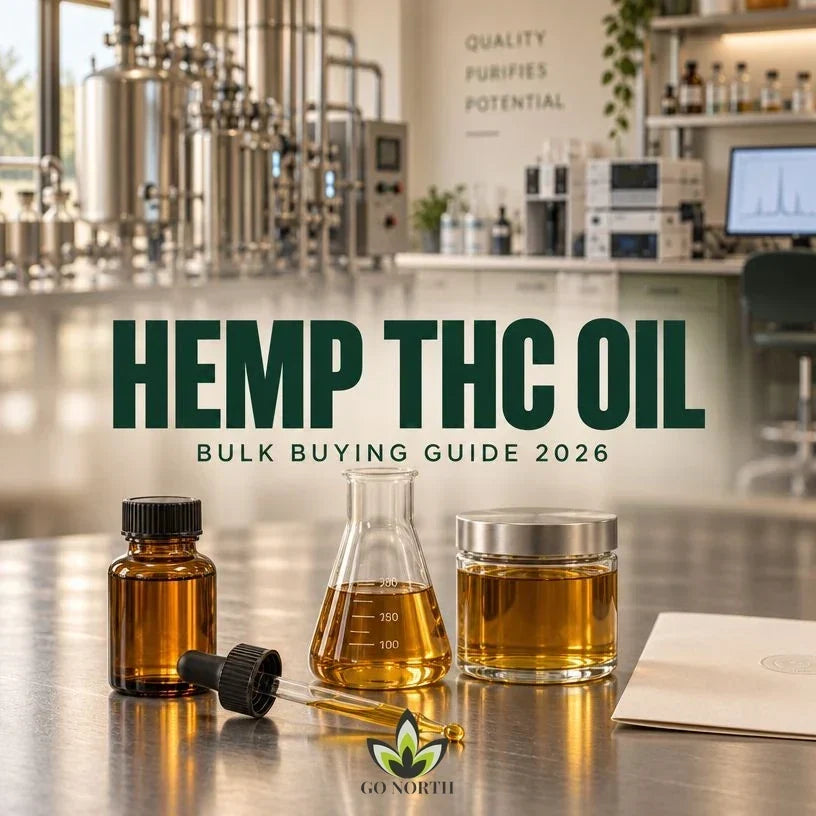
THC oil is any concentrated oil whose primary active ingredient is tetrahydrocannabinol. In the hemp industry context, THC oil means hemp-derived delta-9 THC or delta-8 THC extracted from legally compliant hemp biomass, typically as a distillate. It is a thick, viscous, amber-to-golden oil that formulators use for precise dosing in ingestible and beverage products.
The distinction that matters to wholesale buyers is not THC versus CBD. It is hemp-derived versus marijuana-derived. Under the 2018 Farm Bill, cannabinoids extracted from hemp plants containing less than 0.3% delta-9 THC on a dry weight basis are produced under a federally legal framework. That single distinction determines which suppliers can legally ship to you and which cannot.
Common bulk formats include delta-8 THC distillate, hemp-derived delta-9 THC distillate, and full spectrum hemp oils that carry a compliant delta-9 percentage alongside CBD and minor cannabinoids. Each format has different potency profiles, formulation behavior, and regulatory footprints.
Who Actually Buys Bulk THC Oil?
Professional demand for THC oil comes from five main buyer types. Beverage brands formulate hemp-derived delta-9 into drinks at compliant sub-milligram doses per serving. Edible and gummy manufacturers use distillate for precise, homogenous dosing. Tincture and capsule brands build full spectrum or isolate-plus-THC product lines. Cosmetics and topical brands use THC in formulations where localized delivery matters. Research programs purchase documented lots for formulation studies.
What all five have in common: they buy on documentation, not on marketing. A bulk THC oil buyer's first question is always about the COA, not the price.
THC Oil Specifications: What Good Material Looks Like
Quality THC oil is defined by four specification groups.
Potency: Delta-8 and delta-9 distillates typically assay in the high 80s to mid 90s percentile range for the target cannabinoid. Demand exact numbers on the batch COA, not a marketing range. Your formulation math depends on real potency, and a two-point assay difference compounds into real money at kilogram scale.
Purity: The COA should show a clean residual solvent panel, no detectable pesticides, and heavy metals within acceptable limits. Ask whether the lab holds ISO/IEC 17025 accreditation. Unaccredited lab reports are a documentation risk for your own downstream compliance.
Appearance and behavior: Good distillate is a clear, golden-to-amber, viscous oil that flows predictably when warm and holds a stable consistency at room temperature. Dark, opaque, or gritty oil signals incomplete refinement or aging stock.
Cannabinoid profile: Decide whether your product needs a single-cannabinoid distillate or a full spectrum profile. Single-cannabinoid distillates formulate predictably; full spectrum oils carry minor cannabinoids and terpenes that support an entourage-effect claim but add variability between batches.
Is Hemp-Derived THC Oil Legal?
The legal framework matters more for THC oil than for any other cannabinoid ingredient, so it deserves a direct treatment.
Federally, hemp-derived cannabinoids from material under 0.3% delta-9 THC fall under the 2018 Farm Bill. State law is where it gets complicated: states regulate hemp-derived THC differently, several restrict or prohibit delta-8, and some require specific licensing for THC handling. Before you order bulk THC oil, confirm that both your state and your customers' states permit the format you are formulating, and keep batch COAs with your shipment documentation.
Two habits protect THC oil buyers. First, retain a digital copy of every batch COA for as long as you sell product made from that batch. Second, record which batch went into which production run so any downstream compliance question resolves in minutes instead of weeks.
Bulk Sizing and Pricing Structure
THC oil sells by gram weight, from sample quantities through 100g, 250g, 500g, and 1kg units, with program quotes above that. Price per gram falls sharply as volume rises, and potency interacts with price: an expensive high-potency distillate often costs less per milligram of active THC than a cheaper, weaker oil.
Run the cost-per-active-milligram calculation on every quote. Divide the price per gram by the COA's cannabinoid percentage to compare quotes on equal footing. Suppliers who dodge the cost-per-milligram comparison usually have something to hide.
Budget for samples. A paid sample order of a documented lot is the cheapest insurance in this industry: a few hundred dollars of sample spend protects production runs worth thousands.
How to Evaluate a THC Oil Supplier
The supplier market for THC oil ranges from industrial ingredient producers to resellers with a website and a phone number. Six evaluation criteria separate them.
1. COA practices: Batch-specific COAs from ISO/IEC 17025-accredited labs, available before you pay, with a potency date recent enough to matter.
2. Consistency: Ask for the last three batch COAs and compare numbers. Consistent assays across batches indicate controlled extraction and refinement processes.
3. Transparency about sourcing: Suppliers who know their biomass, their extraction method, and their refinement pathway answer these questions in one sentence. Resellers hedge.
4. Sample policy: Professional suppliers sell documented samples and encourage third-party retesting. Walk away from anyone who refuses samples.
5. Regulatory fluency: A good supplier tells you which states they will not ship to and why. That knowledge protects both sides.
6. Fulfillment reliability: Bulk oil needs controlled handling and predictable lead times. Ask about packaging, thermal handling, and typical turnaround before you build a production schedule around their delivery window.
Formulation and Processing Notes
THC distillate is viscous and needs gentle warming for accurate dosing. Keep working temperatures moderate to preserve potency and avoid degrading the cannabinoid. For beverage work, raw distillate does not mix into water-based products without emulsification, so beverage brands should either run a nanoemulsion step or source a water soluble THC format directly.
For gummies and edibles, distillate's neutral flavor profile is a major advantage over full spectrum oils, which carry hemp taste. Calculate your active dose from the COA, not from the supplier's stated potency, and validate the first production run with a finished-product potency test.
Storage and Shelf Life
Store THC oil in amber glass or stainless steel, away from light and heat, and plan production runs close to material receipt. Cannabinoids degrade under repeated heat cycles, and the terpene fraction of full spectrum oils is the most volatile component. Decant working quantities rather than cycling a bulk container through warm handling areas, and ask your supplier for the extraction date so you know the material's real age.
Start With Documentation, Then Scale
The professional path to buying bulk THC oil is the same as every other cannabinoid ingredient: verify the COA, verify the supplier, buy a sample, validate it against your own standards, and only then commit to production volume. When you are ready to scale, the Go North Hemp wholesale portal supports self-serve ordering with batch COAs attached to every listing.
Frequently Asked Questions
What is THC oil?
THC oil is a concentrated oil whose primary active ingredient is tetrahydrocannabinol, produced as a distillate. In the hemp market it means hemp-derived delta-9 or delta-8 THC extracted from compliant hemp biomass.
Is hemp-derived THC oil legal?
Under the 2018 Farm Bill framework, cannabinoids extracted from hemp with less than 0.3% delta-9 THC on a dry weight basis are federally permitted. State rules vary significantly, so verify the rules in your state and your customers' states before ordering.
What potency should bulk THC oil have?
Quality delta-8 and delta-9 distillates assay in the high 80s to mid 90s percentile range for the target cannabinoid. Demand the exact number from the batch COA and price your formulations from that number.
What does bulk THC oil cost?
Pricing varies with format, potency, and volume, and falls per gram as volume rises. Compare quotes using cost per active milligram: price per gram divided by the COA potency percentage.
Can I buy THC oil online in bulk?
Yes, from wholesale suppliers with documented COAs and sample programs. Professional buyers order samples first, retest independently, and scale to production volume only after validation.
How is THC oil different from CBD oil?
THC oil's active ingredient is tetrahydrocannabinol, which is psychoactive, while CBD oil's active ingredient is cannabidiol, which is not. The two have different formulation uses, regulatory profiles, and consumer applications.
What is THC oil used for?
Primary applications are beverage formulation, gummies and edibles, tinctures and capsules, topicals, and research programs. Distillate's neutral flavor and precise potency make it the standard format for dose-controlled products.
Do I need a license to buy bulk THC oil?
It depends on your state. Some states require handling licenses or restrict hemp-derived THC formats entirely. Confirm your state's requirements and your supplier's shipping restrictions before placing an order.
How do I verify THC oil quality?
Check the batch COA for potency, residual solvents, pesticides, and heavy metals from an ISO/IEC 17025-accredited lab, compare recent batches for consistency, and retest a sample independently before production volume.
What package sizes does bulk THC oil ship in?
Standard tiers run from samples through 100g, 250g, 500g, and 1kg units, with program-level quotes for larger volumes. Bulk oil ships in amber glass or food-grade sealed containers.
Ready to Order Wholesale?
View live cannabinoid lot availability, volume tier pricing, and self-serve ordering on the Go North Hemp wholesale portal. Batch COAs are attached to every listing.
Related Resources for Bulk Buyers
Compare formats across the verified wholesale hemp ingredients catalog, review the Delta-8 THC distillate bulk product page, and pull batch documentation from the COA Transparency Hub before committing to production volume. For volume tier pricing and sample requests, contact the ingredient team or call 971-406-3862. Orders ship from Tigard, Oregon via UPS or Selected Transport Company.