
Cart
0
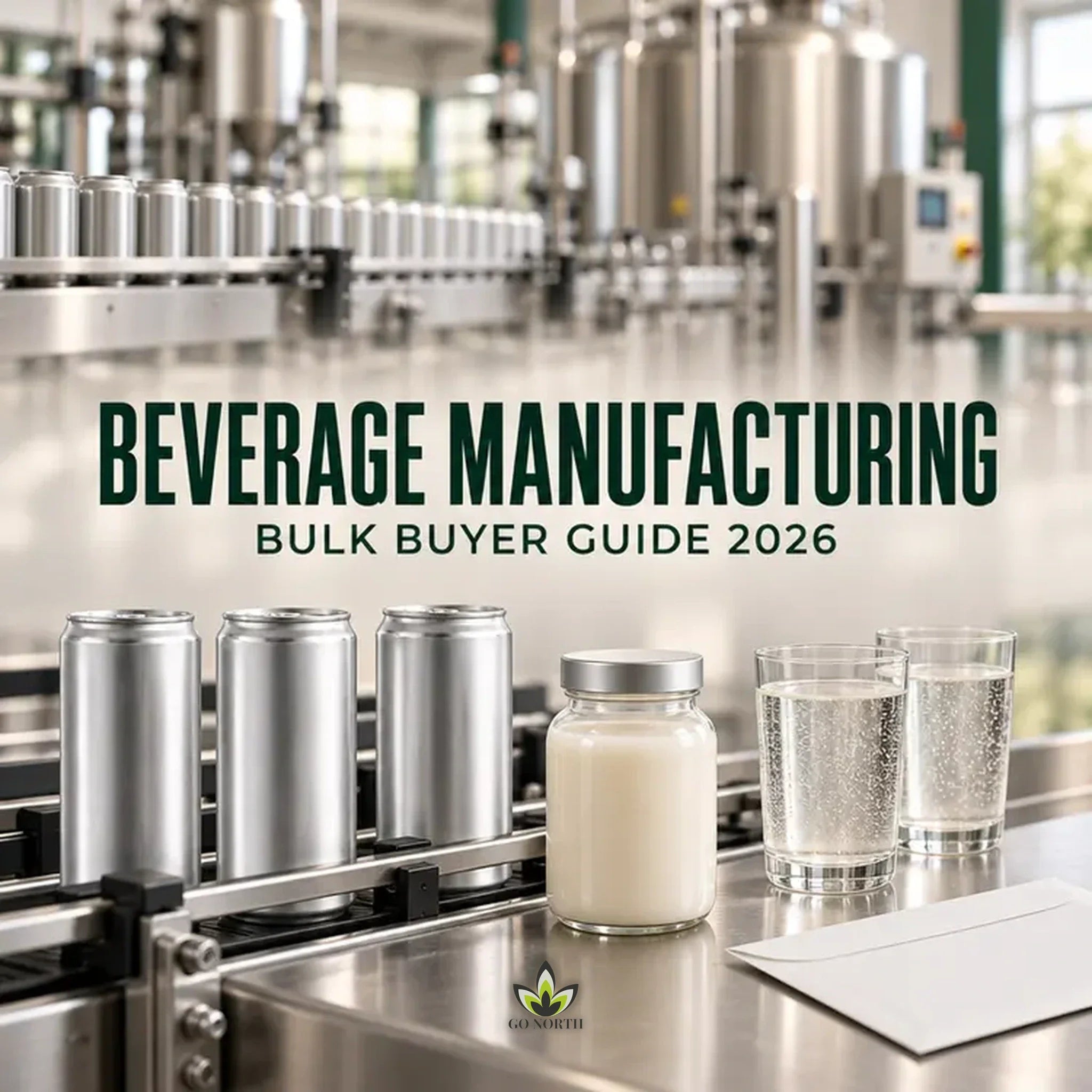

Beverage Manufacturer Buyer Guide: Bulk Cannabinoid Sourcing for 2026
Beverage manufacturers moving into cannabinoid infusion face a sourcing problem that is different from every other buyer category. The ingredient has to disperse, stay stable on a shelf, survive the production line, and taste clean in the final can. This guide covers the specs a beverage manufacturer should require, the formats that work in water-based production, real volume pricing, and how to vet a supplier before committing a production run.
Go North Hemp supplies beverage manufacturing ingredients to brands and co-packers, including water soluble CBD and the full water soluble cannabinoid line, verified by ISO/IEC 17025 accredited laboratories.
Quick Answer: For water-based beverage production, source nano emulsified water soluble cannabinoids, not oil-based distillate. Require a batch specific COA from an ISO/IEC 17025 accredited lab, non-detect THC verification for THC-free claims, and stability data matching your shelf life target. Current catalog pricing: water soluble CBD $540 per kg, CBG $750, Delta 8 and Delta 9 $850, CBN $950, THCP $4,350, with available formats varying by active and Delta 9 pricing shown in powder format. Plan 1 kg to 10 kg per production cycle, sized to your validated demand and validate your thermal process before the first run.
What Beverage Manufacturing Demands From Ingredients

A beverage line is the most demanding application for cannabinoids. In a tincture, a slightly unstable extract is invisible to the customer. In a clear 12 oz can, the same instability shows up as sediment, ring fill, cloudiness, or potency fade before the product reaches the shelf. Sourcing for beverages means qualifying material on four axes: dispersion, stability, potency accuracy, and flavor clarity.
Dispersion. The ingredient must fully integrate into a water-based liquid without separation. Oil-based extracts float and crystallize. Nano emulsified formats are a common water-dispersible option, but dispersion, separation behavior, and ringing must be verified in your actual beverage matrix.
Stability. Potency must hold through the product shelf life, not just on day one. Ask for stability data covering at least your target shelf life at your storage conditions.
Potency accuracy. Every can carries a labeled dose. If actual potency drifts from the COA value, the label claim drifts with it. Tight per-gram potency consistency is what makes batch to batch dosing predictable.
Flavor clarity. Some cannabinoid formats introduce bitter or earthy off notes. Beverage grade material should be tested in your flavor system before production volume is committed.
The Spec Sheet a Beverage Manufacturer Should Require
| Specification | Requirement | Why It Matters |
|---|---|---|
| Water solubility / emulsion type | Nano emulsified powder or liquid | Full dispersion without sedimentation in clear beverages |
| Potency per gram | Verified on batch COA, consistent lot to lot | Predictable dosing per can across production runs |
| THC content | Non-detect result with tested analytes and detection limits documented | Non-detect is a method finding, not proof of zero THC; label claims require finished-beverage testing, substantiation, and regulatory review |
| Residual solvents and heavy metals | Analytical results with reporting limits, evaluated against applicable analyte-specific thresholds | Canned beverage QC and state-level compliance |
| Microbial panel | Results with reporting limits against applicable thresholds | Low water activity products still face finished goods testing |
| Stability data | Covers your target shelf life | Potency and homogeneity must survive the full shelf period |
| COA documentation | Batch specific, ISO/IEC 17025 accredited lab | Every production lot must trace to its own certificate |
Ingredient Formats for Beverage Production
Water soluble powders and liquids are the production standard for infused beverages. Powders dose accurately into dry blending and pre-mix stages, while liquids integrate directly into syrup and aqueous phases. Go North Hemp produces both formats across CBD, CBG, CBN, Delta 8, Delta 9, and THCP.
Crystal resistant distillate at $385 per kg is an option when you are working with emulsion carriers, syrups, or oil-based formulations where crystallization is the failure mode but full water solubility is not required. CRD is designed to reduce crystallization under suitable formulation and storage conditions, is not guaranteed to prevent it, and is not inherently water-soluble.
Broad spectrum formats deliver cannabinoids with THC verified at non-detect on the lot COA. Non-detect means not detected above the lab method limit, not proof of absolute zero THC, and any zero THC label claim on a finished beverage requires its own finished-product testing, substantiation, and regulatory review.
Production Line Considerations

1. Validate your thermal process. If the cannabinoid is added before pasteurization or hot-fill, confirm potency survives the heat exposure. Many producers add nano emulsified material after thermal steps; the right insertion point is process-specific, so validate the approach for your system and account for ingredient stability, mixing requirements, and microbial safety rather than assuming a thermal bypass works.
2. Check homogenization needs. Nano emulsions often work with standard mixing, but mixing requirements are product-specific: verify homogenization needs, microbial safety, and finished-product uniformity for your line.
3. Test pH compatibility with your flavor and preservative system before the first production run.
4. Run a stability hold study on the finished beverage at your real storage temperature, not just ambient lab conditions.
5. Confirm dosing equipment accuracy at your target mg per can, then verify against random cans pulled from the line.
Volume Pricing for Beverage Manufacturers
Current catalog pricing for water soluble formats; available formats vary by active, and Delta 9 pricing shown is the powder format (liquid carries a premium):
| Water Soluble Format | 1 KG Price | 500g Price |
|---|---|---|
| CBD | $540 | $450 |
| CBG | $750 | $525 |
| Delta 8 | $850 | $595 |
| Delta 9 | $850 | $725 |
| CBN | $950 | $665 |
| THCP | $4,350 | $2,827.50 |
Volume tiers below 500g are priced higher per gram, and production volume agreements with committed forecasts are quoted below catalog, subject to product and written quote. Compare quotes on cost per tested milligram of target cannabinoid using the lot assay, not sticker price per kilogram. For a full walkthrough of sourcing specs by cannabinoid, see the Beverage Grade Cannabinoids Buyer Guide.
How to Vet a Beverage Ingredient Supplier

1. Request the batch COA for the exact lot you would receive, issued by an ISO/IEC 17025 accredited laboratory.
2. Ask for beverage or CPG references at production volume, not just sampling customers.
3. Request stability data that matches your shelf life target and storage conditions.
4. Confirm lead times for repeat orders, because line-down waiting on ingredients costs more than any ingredient price gap.
5. Ask about formulation support. Go North Hemp provides custom formulation and the Beverage Fast Track program for brands that need development and canning connections alongside the ingredient itself.
Compliance context for hemp derived cannabinoids in the United States starts with the 2018 Farm Bill definition of hemp, as amended in November 2025 with staged effective dates through December 2026. The ingredient COA documents analytical findings; emulsion stability, processing compatibility, ingredient loading, and finished-product performance require separate technical validation. Confirm serving size, claim language, and state requirements with your regulatory counsel before labeling.
Federal Compliance: Cannabinoid Ingredients for Beverage Production
A bulk cannabinoid ingredient and the finished beverage that contains it are regulated as different things, and sourcing documentation does not bridge the gap.
The 2018 Farm Bill baseline covers hemp extracts with no more than 0.3% delta-9 THC on a dry-weight basis. Federal amendments enacted in November 2025 change that framework in stages: on November 12, 2026, certain intermediate and final hemp-derived cannabinoid products are excluded from the hemp definition, and on December 11, 2026, remaining provisions take effect, including a revised total-THC standard and restrictions affecting certain intermediate products. Concentrated ingredients used in beverage production may fall under intermediate-product provisions, so verify the classification of your specific ingredient at your transaction date.
The finished beverage is a separate question. FDA has taken the position that CBD and THC cannot lawfully be added to conventional foods, and finished drinks are subject to FDA jurisdiction, state restrictions, and destination-market rules. Those restrictions are compound-specific: other cannabinoids, including CBG and CBN, require their own regulatory and food-safety assessment rather than an assumption that CBD or THC rules apply identically. Permissible serving limits, labeling, safety substantiation, and claims require jurisdiction- and product-specific review.
A certificate of analysis documents analytical findings; it is not legal authorization. Confirm current federal law, state restrictions, and destination eligibility with qualified regulatory counsel before producing or shipping any cannabinoid beverage. This guide is commercial sourcing information, not legal advice.
Ready to Order Wholesale?
Live wholesale pricing for water soluble formats is available through the wholesale portal.
COA on every batch, fulfillment to legally eligible, carrier-accepted destinations via UPS or Selected Transport Company, subject to applicable law, documentation, and import and export requirements. Minimums and sample availability vary by product and written quote. Request the current lot COA, formulation specs, and a production-volume quotation, or create a business account for live volume pricing.
Shop Wholesale or call 971-406-3862 for production volume quotes.
Frequently Asked Questions
What cannabinoid format works best for beverage manufacturing?
Water soluble powders and liquids are the standard for infused beverages. Nano emulsified ingredients are a common water-dispersible option for water-based products; dispersion, crystallization, and sedimentation behavior must be verified in your actual beverage matrix. Standard oil-based distillate will not disperse in water. For non-water-soluble needs such as syrup or emulsion base work, crystal resistant distillate is the alternative.
What specs should a beverage manufacturer require from a cannabinoid supplier?
Batch specific COA from an ISO/IEC 17025 accredited lab, verified potency per gram, residual solvent and heavy metal panels, THC content documented with tested analytes and detection limits, noting that non-detect is a method finding and not proof of zero THC, particle size and emulsion type documentation for water soluble formats, and stability data supporting your target shelf life.
How much do water soluble cannabinoids cost per kg?
Current catalog rates: water soluble CBD $540 per kg, water soluble CBG $750, water soluble Delta 8 and Delta 9 $850, water soluble CBN $950, and water soluble THCP $4,350 per kg, with available formats varying by active and Delta 9 pricing shown in powder format. Volume tiers below 1 kg are priced higher, and production volume agreements are quoted below catalog, subject to product and written quote.
Do I need crystal resistant distillate for a beverage line?
Only if you are formulating with oil-based or emulsion carriers. Crystal resistant distillate at $385 per kg is designed to reduce crystallization under suitable formulation and storage conditions, is not guaranteed to prevent it, and is not inherently water-soluble. For clear water-based drinks, water soluble formats are the common choice.
Can cannabinoids survive pasteurization and canning?
Thermal processing can degrade potency if the cannabinoid is added before high-heat stages. Production teams commonly add nano emulsified ingredients after pasteurization or use low-temperature preservation paths; neither approach is universal, so validate the insertion point for your system. Validate your exact process with your supplier and confirm stability data covers your thermal profile.
What MOQ should a beverage manufacturer plan for?
Go North Hemp starts at 100g on many ingredients, with minimums and sample availability varying by product and written quote, covering pilot and sampling runs. Production scale for a beverage line commonly consumes 1 kg to 10 kg per production cycle, where the steepest tier pricing applies.
How do I verify a supplier can support production scale?
Ask three things: batch COA documentation from an ISO/IEC 17025 accredited lab for the exact lots you will receive, references from other beverage or CPG manufacturers at your volume, and confirmation of lead time for repeat orders. A supplier that cannot produce all three should be treated as unverified for production until documentation, capacity, and written commercial terms are confirmed.
How does THC-free beverage production work?
Broad spectrum water soluble formats deliver cannabinoids with THC verified at non-detect on the lot COA. Non-detect means not detected above the lab method limit, not proof of absolute zero THC, and any zero THC label claim requires finished-beverage testing, substantiation, and regulatory review of the specific product and jurisdiction.
What is the difference between the beverage grade and standard cannabinoid specs?
Beverage grade material must disperse cleanly without sedimentation or ring fill, hold potency through the product shelf life, and not introduce off flavors or cloudiness. Standard grade material is formulated for oils, topicals, and capsules and may fail beverage QC without additional emulsification work.
How do I get production volume pricing?
Create a business account at the wholesale portal for live volume pricing, or call 971-406-3862. Production volume agreements with committed quarterly forecasts are quoted below catalog rates, subject to product and written quote, and can lock supply continuity.
Related Resources for Beverage Manufacturers
- Beverage Manufacturing ingredient page
- Hemp Ingredients for Beverage Brands
- Beverage Grade Cannabinoids Buyer Guide
- Water Soluble Delta 9 Bulk Buying Guide
- Crystal Resistant vs Standard Distillate
- Bulk Cannabinoid Ingredients overview
- COA Transparency Hub
Ready to future proof your supply chain?
Visit the COA Hub or contact the Ingredient Team to start your 2026 formulations.
Call 971-406-3862
for trade pricing and live lot availability.