
Cart
0
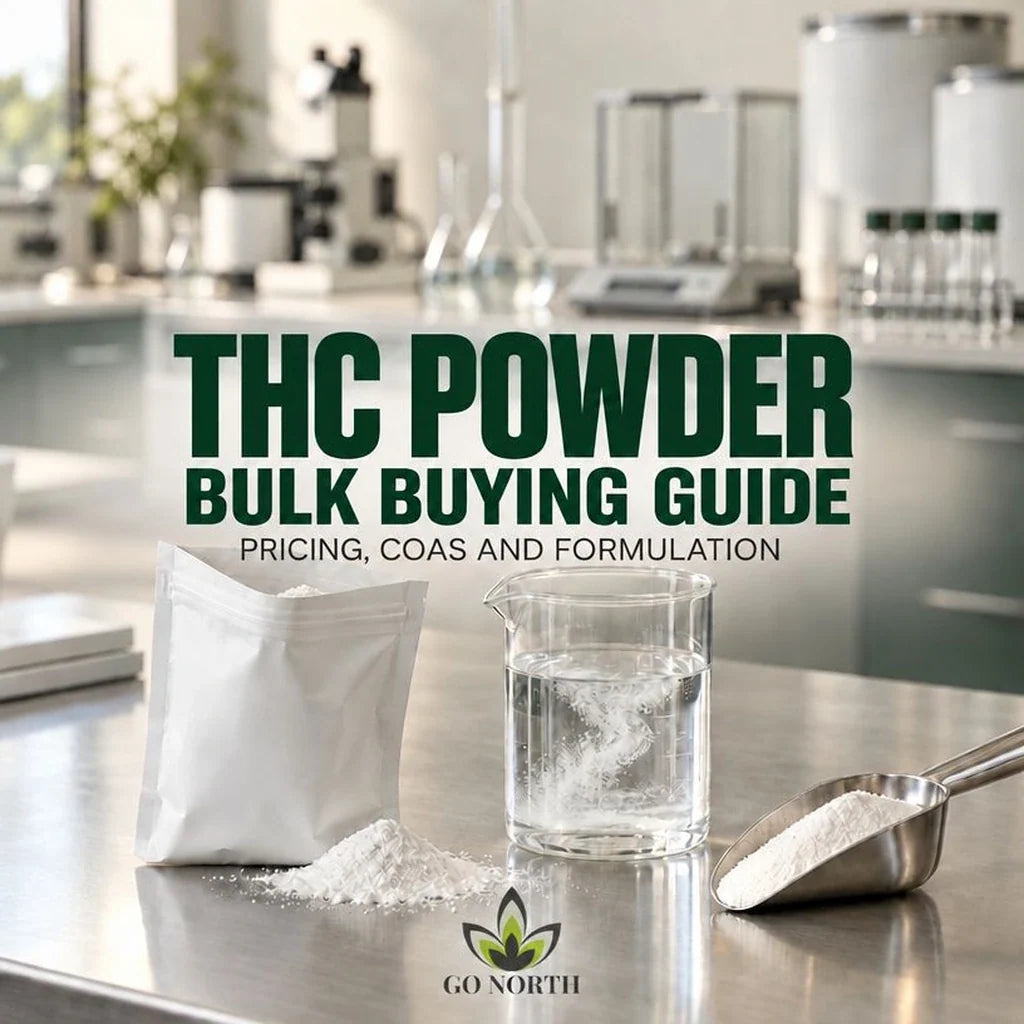

Quick answer. Buying THC powder in bulk means buying a water soluble delta 9 ingredient that disperses in water based systems, not a crystalline isolate and not a distillate oil. The numbers that decide a purchase are potency on the lot COA, price per gram at your tier, and whether your finished product clears the total THC basis and the per container thresholds that take effect December 11 2026.
What Buyers Mean When They Search for THC Powder
The phrase covers several different inputs, and the mismatch is where most bad purchases start. A formulator asking for THC powder in a beverage, drink mix, stick pack or gummy project is usually looking for a nano emulsified, water soluble delta 9 powder derived from hemp, because those formats need an ingredient that disperses in water. Confirm that assumption against your own specification before you order. Those formats need an ingredient that disperses in water.
Three inputs get sold under the same phrase, and they behave nothing alike:
- Water soluble delta 9 powder. A cannabinoid carried on a powder base with an emulsion system, engineered for dispersion in water based systems. This is what a beverage or drink mix project needs.
- Delta 9 distillate. A viscous oil. Excellent in oil based carriers and softgels, and it does not disperse in water without help.
- Crystalline isolate. A purified single cannabinoid, usually CBD rather than delta 9, that dissolves in oil or alcohol and settles out of water.
If your process is water based, only the first input does the job without a second emulsification step you have to engineer and validate yourself. Our current water-soluble HD9 specifications and batch documentation is built for that use case, and the wider water soluble range lists CBN, CBG and THCP formats. Carrier systems and specifications differ between cannabinoids, so check the current batch documentation for the specific ingredient rather than assuming one carrier suits all.
Powder vs. Liquid THC: Choose by Manufacturing Process

Both formats are posted at identical tiers, verified against the live product page on November 9 2026. That is deliberate, because the right answer depends on how you fill, not on what you can afford.
- Powder suits dry blends: stick packs, drink mixes, gummy premixes, capsule fills and anything weighed by mass.
- Liquid suits ready to fill systems: beverages, syrups, tinctures and any line that doses by volume.
Converting a formula from one to the other is not a straight swap. Density, carrier load and the water activity of your finished product all move, so test the finished article rather than assuming equivalence.
Price Tiers, and the Number That Actually Matters
Posted pricing for water soluble delta 9, verified November 2026. Powder and liquid carry the same ladder at every tier:
| Tier | Price | Price per gram |
|---|---|---|
| 50 g | $175 | $3.50 |
| 100 g | $300 | $3.00 |
| 250 g | $600 | $2.40 |
| 500 g | $725 | $1.45 |
| 1 kg | $850 | $0.85 |
Read the third column, not the second. A buyer comparing a 50 g price against a competitor kilo price is comparing two different businesses, and a per gram comparison only holds when the two lots carry similar potency and carrier load. Moving from the 50 g tier to the kilo tier cuts the cost per gram by about 76 percent, and from the 100 g tier by about 72 percent. That tier step is usually a bigger lever than negotiating a discount.
Cost per milligram of delta 9 needs one more input: the potency on your lot COA. Take the milligrams of delta 9 carried in one gram of the ingredient, then divide the price per gram by that figure. At the kilo rate the ingredient costs $0.85 per gram, and a lot testing at 20 percent delta 9 carries roughly 200 mg per gram, so the cost lands near $0.0043 per milligram. Dividing the price by the potency percentage itself does not give a per milligram figure, and a higher potency lot lowers the cost per milligram even when the price per gram is unchanged. Use your own lot figure. Potency moves between batches, and the cannabinoid price index tracks the market side of that math.
The Compliance Dates That Change a Purchase Decision
Two dates sit inside any 2026 purchasing plan, and both are worth checking against your specific product before you place a bulk order.
November 12, 2026. Federal hemp definition exclusions take effect for cannabinoids that cannot naturally be produced by the cannabis plant. Separate provisions cover naturally occurring cannabinoids that are synthesized or manufactured outside the plant, and those follow the later December 11 schedule. Verify both the cannabinoid and how it was produced rather than assuming that hemp origin alone settles compliance.
Neither date applies only to finished products. The revised hemp definition determines whether a concentrated THC ingredient itself qualifies as hemp, which is a separate question from whether a finished product can meet the applicable limits. A bulk water soluble delta 9 ingredient has to be assessed on that ingredient-level basis in addition to any finished product test.
December 11, 2026. Additional federal hemp definition changes take effect, including a 0.3% total THC standard that counts THCA and other tetrahydrocannabinols, and a 0.4 mg combined total per container threshold for finished products. The same amendments exclude certain intermediate hemp derived cannabinoid products above 0.3% combined total THC and other qualifying THC-like cannabinoids. A concentrated water soluble delta 9 ingredient has to be assessed as an intermediate product where that classification applies, so ask the supplier how the ingredient is positioned and what documentation supports that position.
Work through the full hemp compliance checklist for 2026 before you commit to a formulation, and confirm the applicable rule for your category and destination with counsel. Nothing here is a compliance determination for your product.
One point sits outside the hemp framework and matters for the formats this ingredient usually goes into. Federal food law is a separate restriction. The FDA's published position is that introducing food or beverages containing added THC into interstate commerce is prohibited under section 301(ll) of the Federal Food, Drug, and Cosmetic Act, subject to applicable statutory exceptions. Meeting the federal hemp definition does not by itself authorize a THC containing beverage or drink mix. That is a separate federal question from the hemp rules above and needs its own review before you rely on any food or beverage use, so a drink mix or beverage application carries a separate federal food law question regardless of how the THC figures land. Raise that with counsel alongside the THC calculation.

What a THC Powder COA Has to Show
A batch specific Certificate of Analysis is central to verifying an ingredient, but read it alongside current specifications, lot traceability and the quality documentation behind it. For reference, Go North Hemp's published HD9 documentation reports 19.72% delta 9 THC and 22.02% total cannabinoids for a previously tested batch. Those figures are historical and are not a substitute for the COA of the lot you buy. Ask for the full report and check six things:
- Lot match. The lot number on the COA matches the material in your shipment, not a generic batch page.
- Accreditation and scope. ISO/IEC 17025 accreditation is only meaningful if the scope covers the analyses being reported.
- Reporting limits. A non detect result without a stated limit tells you nothing about the concentration you were actually exposed to.
- Potency expression. Delta 9 reported separately from total potential THC, with the conversion basis stated.
- Contaminant panel. Pesticides, heavy metals, microbials and residual solvents, each with a limit and a result.
- Dates. Collection and report dates, so you know how old the evidence is.
Summary pages that list potency alone are the most common documentation gap on inbound lots. Ask for the package before price, because a supplier who cannot produce it will not produce it after you have paid either.
Formulation Notes Before You Commit

Four things decide whether a water soluble powder behaves in your finished product:
- Dispersion and settling. Test for ring formation and sediment across the shelf life you intend to claim, not on day one only.
- Taste and mouthfeel. Carrier systems vary in what they contribute. Taste the finished article at your planned dose before scaling.
- Process heat. Pasteurization and hot fill steps put the emulsion under stress. Confirm the thermal limits of the specific carrier with your supplier.
- Potency through shelf life. Establish the finished product potency and stability with validated testing at the storage intervals you intend to claim. Any manufacturing adjustment has to be supported by that stability data and checked against potency, labeling and legal limits rather than assumed.
Beverage specific mechanics sit in the HD9 beverage formulation guide, and the wider format comparison is in the water soluble delta 9 bulk buying guide.
Five Checks Before You Buy THC Powder
- Match the input to your process. A water based system generally needs a validated dispersion or delivery system, which may be supplied as a powder or as a liquid. Conventional distillate or crystalline isolate are not interchangeable with a finished water dispersible ingredient without additional formulation work.
- Price per milligram, not per kilo. Combine your tier price with the potency on the lot COA.
- Request the full COA package and confirm accreditation scope and reporting limits.
- Run a small finished product trial before committing to a bulk tier, and test at end of shelf life.
- Check the December 11 rules against your container size and destination before you finalize a label claim.
Frequently Asked Questions
What is THC powder, exactly?
In bulk supply it usually means nano emulsified water soluble delta 9 THC powder derived from hemp. The cannabinoid is carried on a powder base that disperses in water based systems such as beverages, drink mixes and stick packs. It is not the same as a crystalline isolate and it is not the same as delta 9 distillate, which is an oil.
Is THC powder the same as delta 9 distillate?
No. Distillate is a viscous oil that blends into oil based carriers. Water soluble powder is engineered to disperse in water. Particle size, carrier composition and the emulsion system are what separate the two formats, and those differences decide which one belongs in your formula.
What does THC powder cost per kilo?
The posted ladder runs $175 for 50 g, $300 for 100 g, $600 for 250 g, $725 for 500 g and $850 per kilo, and powder and liquid are posted at the same price at every tier as of November 2026, so confirm the live figure before you commit to a format. Price per gram falls from $3.50 at the 50 g tier to $0.85 at the kilo tier, so the tier you buy at is the single biggest input cost variable you control.
How do I work out cost per milligram of delta 9?
Convert the potency on your lot COA into milligrams per gram first, then divide the price per gram by that number. At the kilo rate the ingredient costs $0.85 per gram, and a lot testing at 20 percent delta 9 carries roughly 200 mg per gram, so the cost lands near $0.0043 per milligram. Dividing price by the potency percentage itself does not produce a per milligram figure. Use your own lot data.
Does the December 2026 change affect THC powder?
It can. From December 11 2026 the interstate THC limit moves to a total THC basis covering THC plus THCA, and an exclusion applies to certain finished hemp derived cannabinoid products above 0.4 mg combined total per container, counting total THC plus other specified THC-like cannabinoids and measured per container rather than per serving. That figure works as a classification threshold for specific product types rather than a blanket label rule. Confirm how it applies to your category and destination with counsel before you commit to a formulation, and confirm the classification of this concentrated ingredient specifically rather than assuming it sits in the same bucket as a finished product.
What should a THC powder COA show?
A lot number that matches your shipment, the laboratory ISO/IEC 17025 accreditation and the specific scope it covers, reporting limits for each analyte, potency as delta 9 and total potential THC, a contaminant panel, and clear collection and report dates. Ask for the full report, not a summary page with the analyte list stripped out.
Powder or liquid, which should I order?
Powder suits dry blends such as stick packs, drink mixes and gummy premixes. Liquid suits ready to fill beverages and syrups where a measured volume is easier to handle. Both are listed at the same price per tier, so the decision belongs to your process, not your budget.
Will the powder settle or ring in a finished drink?
Dispersion quality comes down to the emulsion system and the carrier, not to how hard you mix. Test your finished product for settling, ring formation and mouthfeel across the shelf life you intend to claim, and treat supplier dispersion claims as a starting point rather than a guarantee.
What is the minimum order?
Posted tiers run from 50 g to 1 kg, with pricing shown on the product listing. Smaller research quantities and sample availability should be confirmed with the Ingredient Team, and current minimum order quantities can change with lot availability. Larger production volumes are quoted in writing, covering quantity, current lot, packaging and delivery requirements.
What lead time should I plan for?
Published tier pricing is not a delivery commitment. Confirm current lot availability, processing time, packaging, destination restrictions and freight in writing before you set a production date, and get the dispatch window confirmed for the specific tier you are ordering. Recurring wholesale volumes may need a separately agreed production schedule.
How do I verify a supplier before ordering THC powder?
Send your specification and ask for the current lot COA before you talk price. Confirm the accreditation scope covers the analyses you need, ask how lots are tracked from batch to shipment, and ask which destinations the supplier ships to today rather than relying on a published list.
Ready to future proof your supply chain?
Get instant access to trade pricing, live lot availability, and batch COAs on every order. Business verification unlocks preferred pricing for your account.